Manor Farm, Sparkford
Sparkford Manor
otherwise known as the Manor of Sparkford Farm
There remains much uncertainty about the precise location of "Sparkford Manor". There is no "manor" extant in Sparkford, only a Manor Road off Church Road, leading to the church where Henry Newman and his son Edwin Sandys Newman were rectors during and after the family's ownership of the nearby estate. One possibility is that there was never a manorial house at Sparkford and that Sparkford Manor was in fact the "manor at Sparkford", or "the manor of Sparkford Farm" wherein the word manor was used to describe the collection of lands and buildings incorporated within the farm estate. This hypothesis is supported by the fact that there is no genealogical evidence (that I am aware of) to suggest that the Newmans owned (let alone lived in) a manor house at Sparkford. It's further supported by the fact that there are only references to "Sparkford Farm" and "the manor at Sparkford" (with a small 'm' for manor) in the several 18th Century Chancery Court proceedings unearthed by researcher Susan Moore.
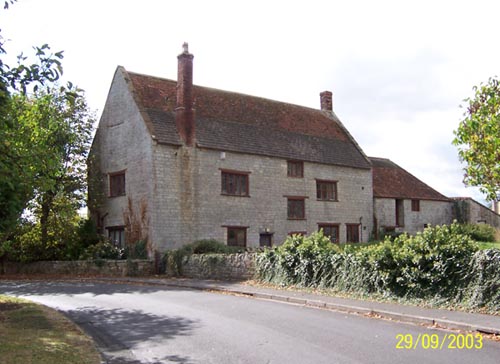
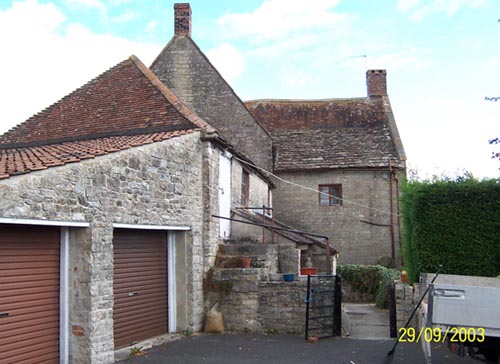
If the above hypothesis has credence enough to support further deduction, then perhaps the most likely candidate for the main dwelling house of Sparkford Farm is "Manor Farm" (sometimes known as Sparkford Hill Farmhouse and Sparkford or Manor Farmhouse), which is located on the corner of Church and Manor Roads. This farm house, despite its rather newly and badly repointed stonework, appears to date back rather further than other houses in its vicinity. According to researcher Di Clements, it is:
"listed as 17th Century and was built on a T plan. [Ancient Monuments don't always get it right, as in the case of my own house, also T shaped, which they described as 16th and 17th Century, but was found by a Vernacular Architect to be 1450 Hall house with cruck beams etc. with later additions.]"
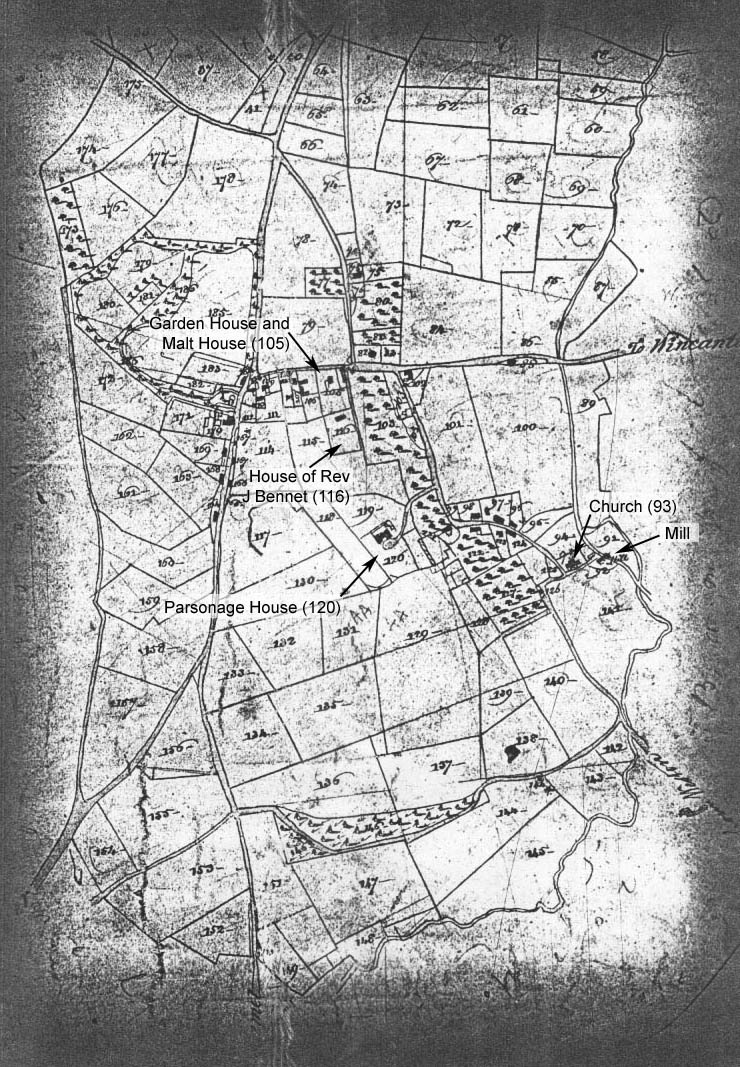
Another possibility is that Sparkford Manor was (or was at the location of) Sparkford Hall, which was once owned by the same Bennett family that bought "Sparkford Manor" from the Newmans. According to Di Clements, references to it don't seem to appear until the 19th century, and it seems likely that the Bennetts actually built Sparkford Hall. However that does not preclude the possibility that it was built on the site of an earlier manorial building. According to Di Clements, Sparkford Hall is located at #120 on Tithe map below and is described as mid-19th Century, but possibly incorporating earlier work. Unfortunately, I have not yet seen this building, nor have I any photographs of it.
No matter where the manor house stood, or whether there ever was a manor house, it would appear from the description in Chancery Proceedings C12/629/31 (Bill of complaint dated 23 Nov 1786), that Sparkford Farm was not a small estate. To quote from the document: "All that messuage farm or lands called Sparkford Farm in Sparkford co. Somerset containing 400 acres then or late in the tenure of William Welch thereof to the said Francis Newman the elder, that is to say the farm house barton and orchards adjoining by computation 6 acres .. Pastures of Blacklands of 20 acres, Wool Fister of 400 acres, Great Gaston of 14 acres, Hither Marsh 8 acres, Younder Marsh 10 acres, Church Way 10 acres, Coppice Close 14 acres, Fishers Gaston 8 acres".
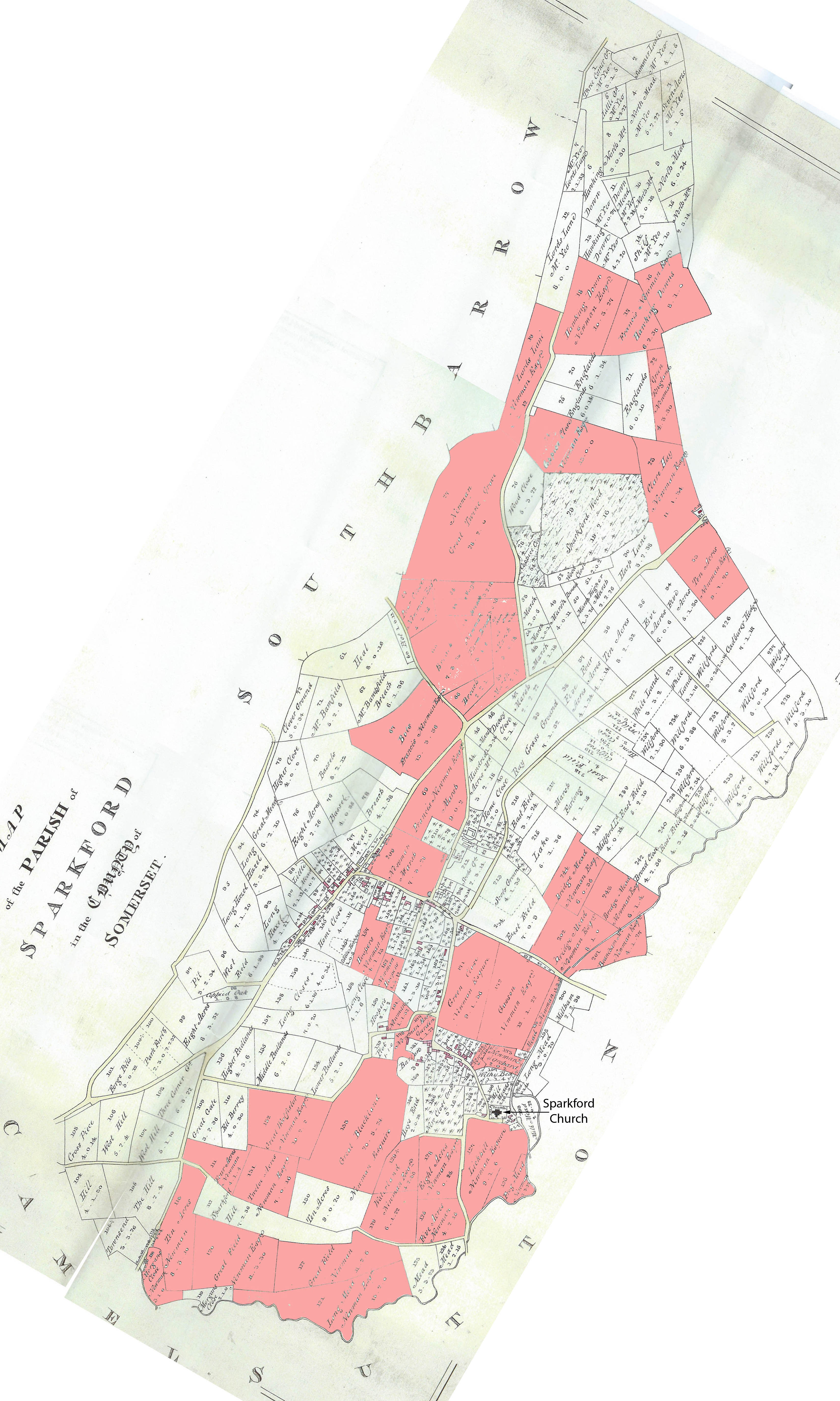
The undated map below was discovered in the Somerset Records Office. It shows the lands owned by Francis Newman, so must be assumed to date from 18th century, these lands being hightlighted in pink.
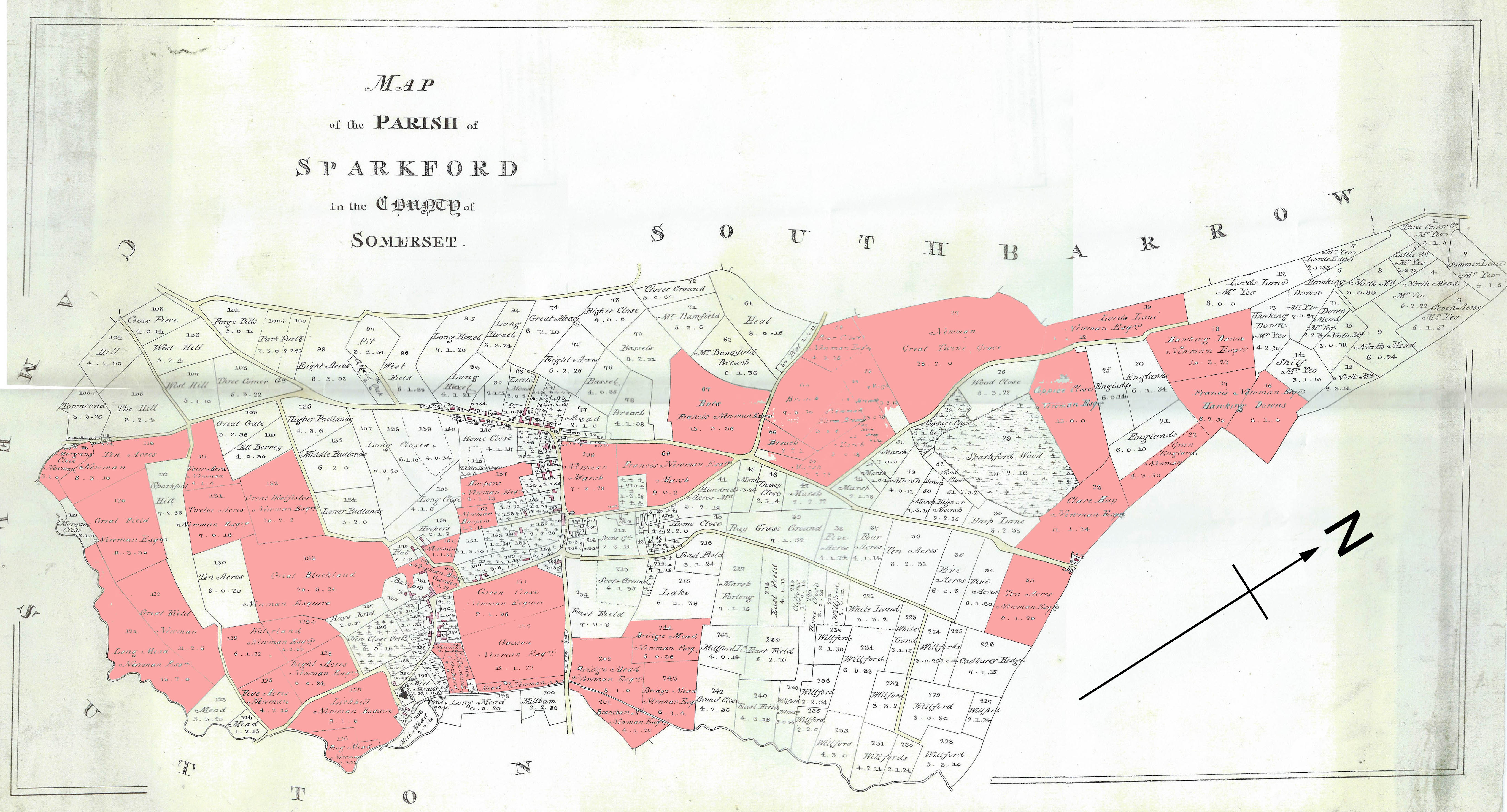
A rotated copy of the map is shown below.
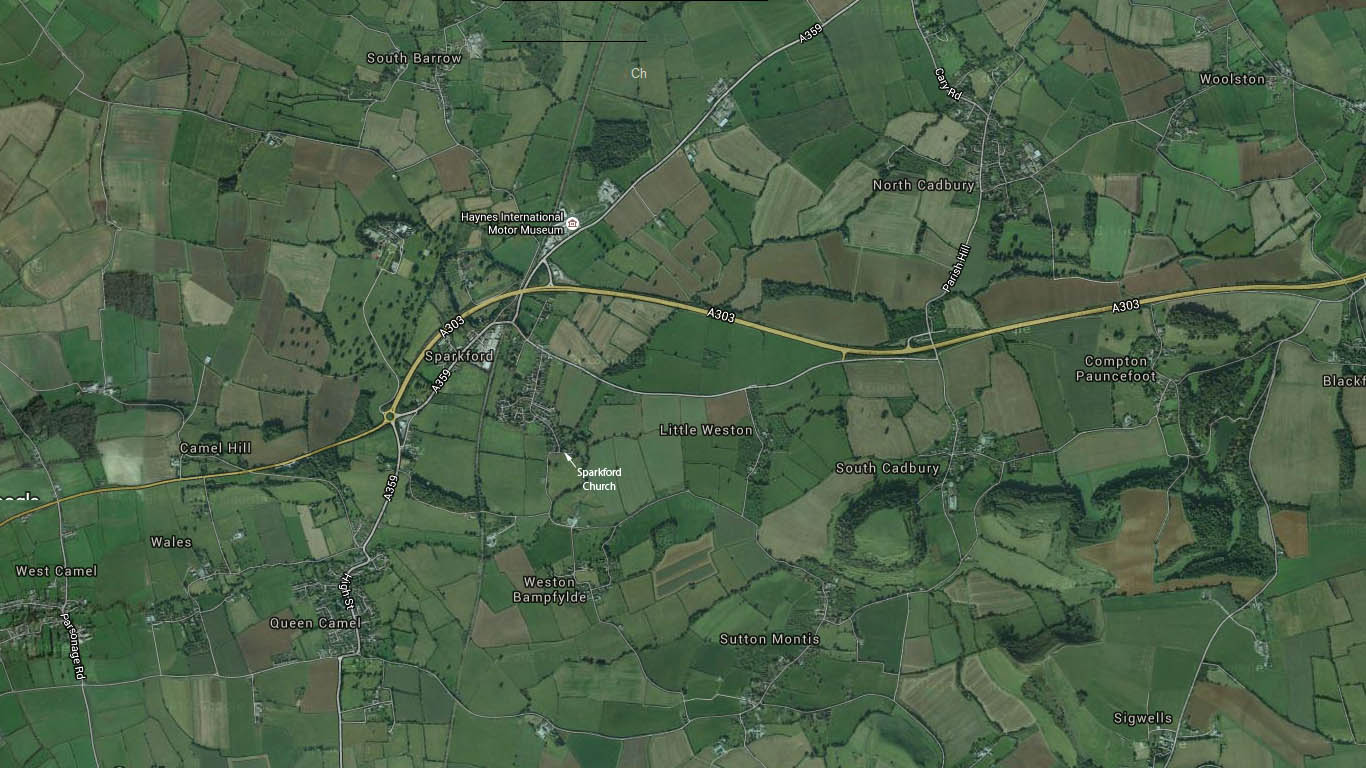
Below is a copy of the Google map of Sparkford with a rotated view of the above map correctly orientated. The location of Sparkford Church is shown on both maps.
The map below (sent to me in 2003 by Di Clements) shows the village of Sparkford as it once was. The map is not dated, however it must have been made before the arrival of the railway which formed part of the planned Wilts, Somerset and Weymouth Railway, being completed by the GWR in 1881.
Oddly, the plot numbers on the map bear no relationship with those shown on the map above.
Di also offered other comments of possible interest:
"Also perused DD/X/BE 4 re Manor of Sparkford; 1835 Deed between Rev. Henry Bennet of S Cadbury and James Bennet of Cadbury House re Sparkford Farm, owned by Frances Whatmore wid 400 acres. There is pasture called Church Hay and a reference to the Messuage Farm. Attached to the papers is an Indenture of Lease and Release dated Feb 1783. The first Schedule was between Francis Newman of N Cadbury Esq.of the first part, Francis Newman the younger his nephew, the eldest son of Rev. Henry Newman and his wife, daughter of Francis Newman the the uncle of the second part. This shows that Newmans once owned Sparkford Farm, which could have once been the Manor House.
From SDNQ [Somerset and Dorset Notes and Queries] I found there was a deed 1791 between Francis Newman late of Broad St London but now of Cambridge, Esq (must be and others, which refers to 'Sparkeforde farme'. The whereabouts of the Deed is not mentioned. In another Volume printed 1893, the writer refers to four Armorial Shields. One and two 'were shown me by the late Rev James A Bennet who brought them from Sparkford House' This seems to me to be the most significant piece of infomation.
From Kelly's Directories: 1861 Henry Bennett was at Sparkford Hall and calling himself Lord of the Manor. And in 1894 Sparkford Hall is described as having park-like grounds with with entrance drive.
In the census for 1851 only servants were living in the Hall. Henry Bennett was in the Rectory."
(From my own notes, written long before any of the above) According to Harold Biggs' researches, it was Richard Newman of Queen Camel who purchased Sparkford Manor in 1610. How it came into the possession of the Fifehead Newmans is not currently known..
Be that as it may, Sparkford (along with the two Cadbury estates) was divided from the Evercreech and Fifehead estates which went to the elder son of Richard Newman (d.1695) . Sparkford and Cadbury were inherited by Col. Richard's younger son Francis Holles Newman. The Sparkford estate continued in the family for two more generations until 1796 (after the death of Francis Newman of North Cadbury) when it was sold to the same Bennett family that bought Cadbury Court, to pay off the debts of Francis's nephew Francis Newman. [Note: In fact, it appears that the estates were first mortgaged to the Bennetts to raise money to pay Francis's debts in order to get him out of debtors prison.]
In 1758, Henry Newman became rector of Sparkford Church, being followed by his son Edwin Sandys Newman in 1796 - which may have been after the estate was sold to the Bennetts (see below). Edwin Sandys Newman retained the rectorship for another 40 years until his death in 1836, whereupon it passed (like the estates before it) to the Bennett family. See Henry Newman's page for photos of Sparkford Church.
An extract from 'The History and Antiquities of Somerset' by John Collinson 1791, as found for me by Di Clements:
"In very early times this composed part of the great barony of the Lovels, the Lords of Castle Cary. 12 Hen. II. Ralph de Sparkeford, so denominated from the place, held one knight's fee here of Henry Lovel, and his descendants long continued tenants under the succeccive possessers of this lordship.It was however sometime held by the family of Burnell, of whom was Robert Burnell, Bishop of Bath and Wells in the time of Edward I. After these came the Handlo's and the Roger's, successive mesne lords of this place; but the Lovels were Lords paramount, and from them it descended in the same manner as Castle -Cary to the Seymours, the Lords Zouche of Harringworth, Willoughby Lord Broke, and was at length purchased by Richard Newman, esq (Richard Newman of Fifehead) whose descendant Francis Newman of North Cadbury, esq; is the present possessor. The living is rectorial, in the deanery of Cary,and in the patronage of Francis Newman esq; above-mentioned. The Rev. Mr. Newman is the present incumbent."
[Extract from Phelps also obtained for me by Di Clements]:
"It was next possessed by Richard Newman, Esq. (Richard Newman of Fifehead) about 1610, from whom it descended to Francis Newman, Esq by whom it was sold in 1793, to James Bennett, Esq. who on his death devised it, with the advowson of the church, to his second son, the Rev. Henry Bennett, who now possesses the property, and holds the living. The whole parish, with the exception of a few fields, belongs to the Lord of the Manor."
However, as with Phelps's commentary on Cadbury Court, confusion arises about the date of the sale of Sparkford Manor to the Bennetts - given a 1793 above, because Francis Newman's Will dated 25 October 1794, refers specifically to his estates in Sparkford and Cadbury. Furthermore, the statement that the advowson rights of the Sparkford church passed to the Bennetts in 1793, and that the living from it was granted to Henry Bennett that same year, is inconsistent with the counterclaim (as evidenced in the church itself) that Edwin Sandys Newman became rector of Sparkford Church on the death of his father Henry Newman in 1796 and held the post until his own death in 1836 when Henry Bennett took succeed him - see church record on Henry Newman's page. Phelps's version history must therefore be considered questionable in this instance.
Last updated 11th Aug 2020 - revised information about ownership thanks
to Harold Biggs.
Updated 17th Sep 2015 - addional map of Sparkford added showing
Newman lands.
Last updated 6th Nov 2003