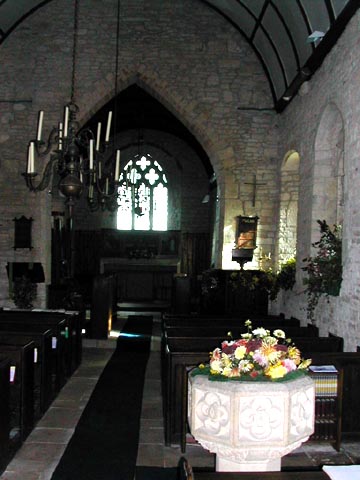
Fifehead Magdalen Church
[See separate page for Fifehead
Manor]
The connection between Newmans and Fifehead extends back to 1405 when John Newman (brother of Robert Newman of St. Thomas's, Salisbury) was Rector there. According to Peter Oxlade's account, the Newmans first leased the manorial estate from its Lord, the Abbot of St. Augustine's Abbey, Bristol, from 1408. This disagrees with the information in Wayne Newman's April 1998 article in the Newman Chronicle suggesting that the first lease over the Fifehead estate was taken out in 1530 by Robert Newman of Fifehead. At any rate, the freehold over the Fifehead estate was purchased by Richard Newman (d.1695) in 1660, after which it remained in the family until the death of Frances Newman in 1775, whereafter it was sold (in 1779) to the brother of a vicar of the parish. Thus the Newman family's connection with Fifehead lasted for almost 400 yeas "giving a sense of stability to the village" [quoted from Peter Oxlade's 1840 account].
An 8 page brochure prepared for visitors to the church gives a more detailed account of the link between the Newmans and Fifehead.
See separate page for information about Fifehead Manor House.
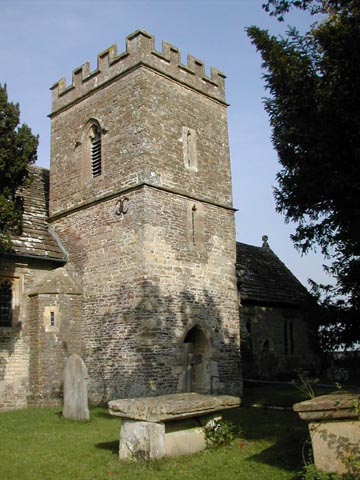
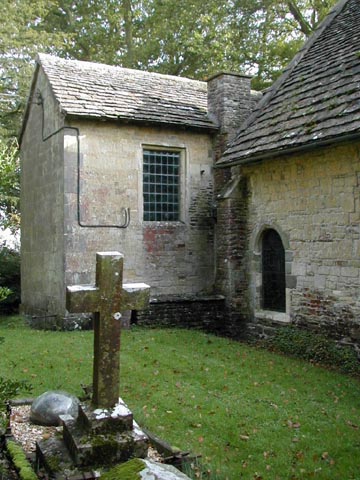
Fifehead Church; (see also photos below of Newman Chapel)
The village church at Fifehead Magdalen is dedicated to St. Mary Magdalene after whom the village is named. It dates mostly from the 14th century. Its most striking feature is the small "Newman chapel" built onto the north side of the nave in 1693. The chapel was built by Sir Richard Newman of Fifehead, Preston Hall and Evercreech (1676 - 1721), a member of the Newman family which held the Fifehead manorial estate for almost 250 years from c.1530 until 1775. [Note: the Newmans' tenue of the estate may have dated back to 1405 or 1408 according to Peter Oxlade's 1840 account.]
Further information about the church can be found at http://stourvalechurches.org.uk/churches/fifehead-magdalen/ and from Wikipedia.
Note:A photocopy of an unidentified document has been unearthed, listing the monument inscriptions that may be found both inside and outside Fifehead church. A transcription can be downloaded here which includes scans of the 'original' photocopy.
Newman Chapel - Fifehead
In the little church at Fifehead Magdalen is a small chapel on the north side of the chancel that was built by Sir Richard Newman in 1693. The chapel contains three wall-mounted memorial stones, a small one on the west wall, a larger one on the east wall, and a very large one on the north wall. In 2016 these were found to be in need of cleaning and restoration, in particular the largest one which was discovered to be in a state of near collapse. Thanks to successful fundraising efforts of Rosemary Redwood (the treasurer, secretary, electoral roll officer and chief fund raiser for the parish), a contract was awarded to Sally Strachey Historic Conservation Ltd of Wells, Somerset who carried out the work over the first half of 2018. A copy of her fascinating report on the work can be downloaded by clicking here (18MB PDF document).
Newman Chapel West Wall: The memorial on the West Wall is dedicated to Richard Newman of Evercreech Park (1650 - 1682).
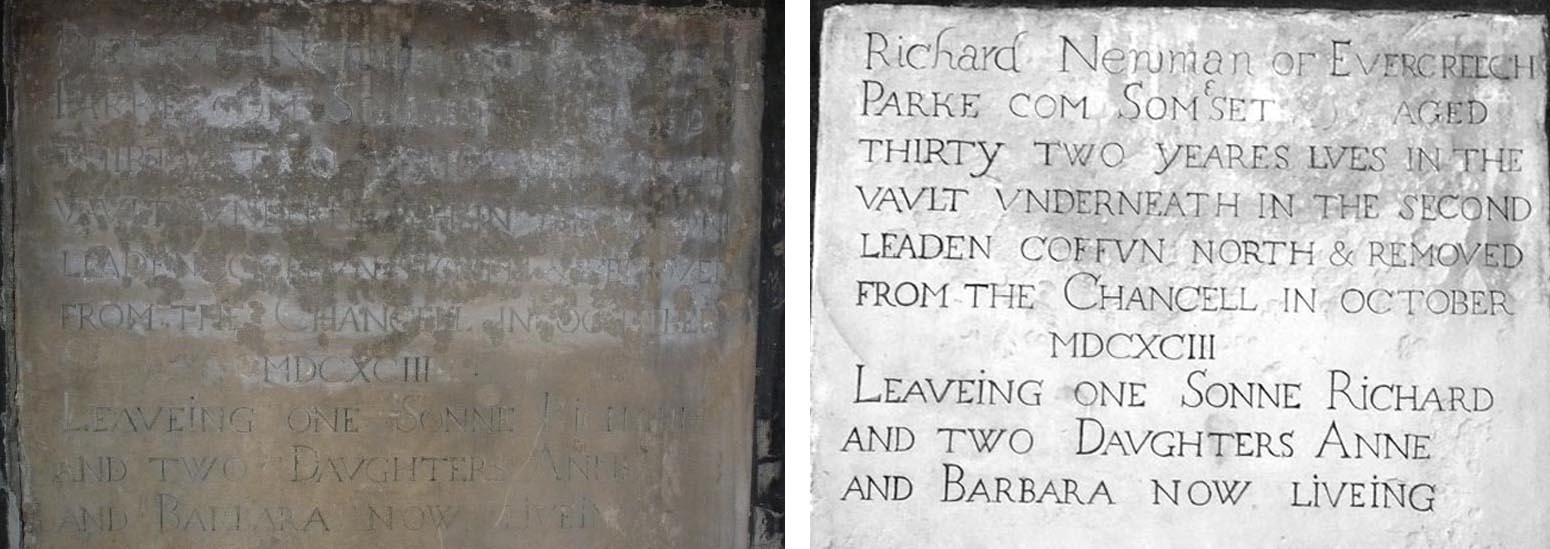
The images above show the monument's inscription in 2012 and 2018 (after restoration). The state of the monument in 1870 when John Hutchin wrote his History of Dorset page 58 must have been much better than it was in 2012 since he was able to provide an accurate transcription as follows:
"Richard Newman
of Evercreech Parke com Someset ??? aged 32 years,
lies in the vault underneath in the second leaden coffin north,
and removed from the Chancell in October M.D.CXCIII [1693];
leaveing one sonne Richard, and two daughters Anne and Barbara now liveing."
Newman Chapel East Wall: The marble memorial on the East Wall is dedicated to Thomas Newman of Fifehead and his son Richard Newman (see below)
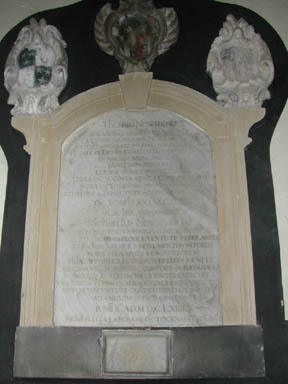
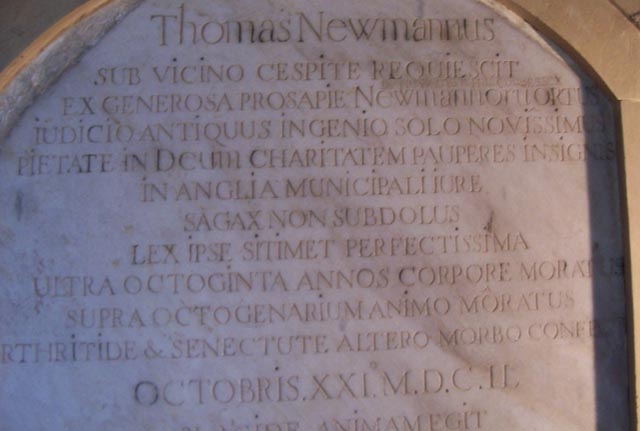 Memorial to Thomas Newman who died 21 Oct 1649* photo by Chris Newman Oct 2004
* Note - John Hutchin's History of Dorset (page 58) incorrectly shows the date on the inscription as MDCII = 1602 |
|
Ex generosa prosapie Newemannoru [de Newman Hall cohr(?) Essex] ortus Judicio antiquus ingenio solo novissimus Pietate in Deum charitatem pauperes insignis In Anglia municipaliiure Sagax non subdolus Lex ipse sitimet perfectissima Ultra octoginta annos corpore moratus Supra octogenarium animo moratus Arthritide & senectute altero morbo confect Octobris XXI, M.D.C.IL placide animam egit |
From the lineage of Newman of Newman Hall Essex Following time-honoured values, humble and down-to-earth Loving God, caring for the poor and for English law Wise and straightforward Law-abiding and accomplished Over eighty years in body But younger in mind Suffering from arthritis and other effects of age October 21, 1649 Peacefully passed away |
Note: the words "de Newman Hall cohr(?) Essex, ortus" appear to have been inserted into the inscription at a later date - see enlarged photo below:

It is not known when or why these words were added or by whom, but perhaps someone believed that the Thomas Newman who built Newman Hall in Essex sometime around 1540 was the same Thomas Newman who is memorialized here. Given that this Fifehead Thomas Newman died in 1649, he could not be the same Thomas Newman who built Essex Hall, but that does not prove that there was no connection between the two families.
Newman Chapel East wall (continued): Memorial to Richard Newman who died 10 June 1664
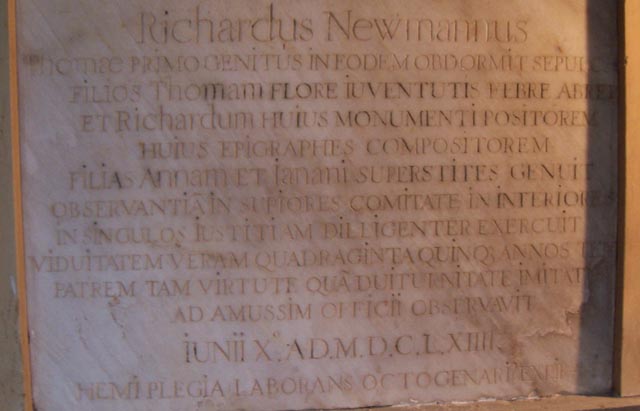 photo by Chris Newman Oct 2004 |
|
Thomae primogenitus in eodem obdormit sepulcr[um] Filios Thomam flore juventutis febre abrep[tum] Et Richardum huius momenti [com?]positorem Huius epigraphes compositorem Filias Annam et Janani superstites genuit Observantia in supiores comitate in interiores In singulos justitiam dilligenter exercuit Viduitatem veram quadraginta quinq[ue] annos ten[?] Patrem tam virtute qua diuturnitate imitatus Ad amussim officii observavit Iunii X, AD. M.D.C.L.XIIII Hemi plegia laborans octogenari expiravit |
Thomas's first-born asleep in the same grave Son Thomas snatched by fever in the bloom of youth And Richard important composer[?] Composer of inscriptions Survived by daughters Ann and Jane Extremely courteous and observant Singularly diligent in the exercise of justice Bereaved[?] at 45 years Imitating the longevity of his father Exacting in his observance[?] June 10, 1664 Died at eighty years of age |
Atop the monument are three escutcheons containing faded coats of arms. Photos taken during the 2018 restoration are shown below:
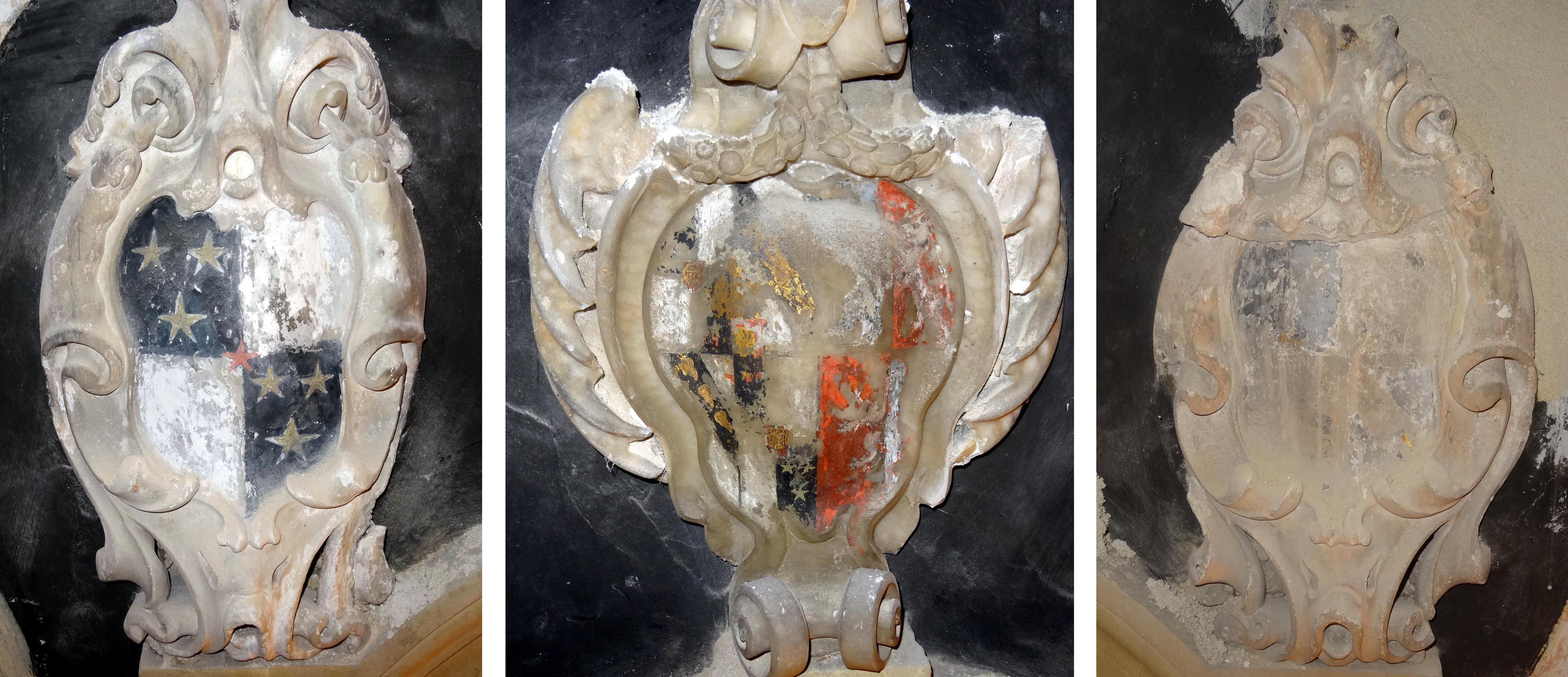
Points of interest are as follows:
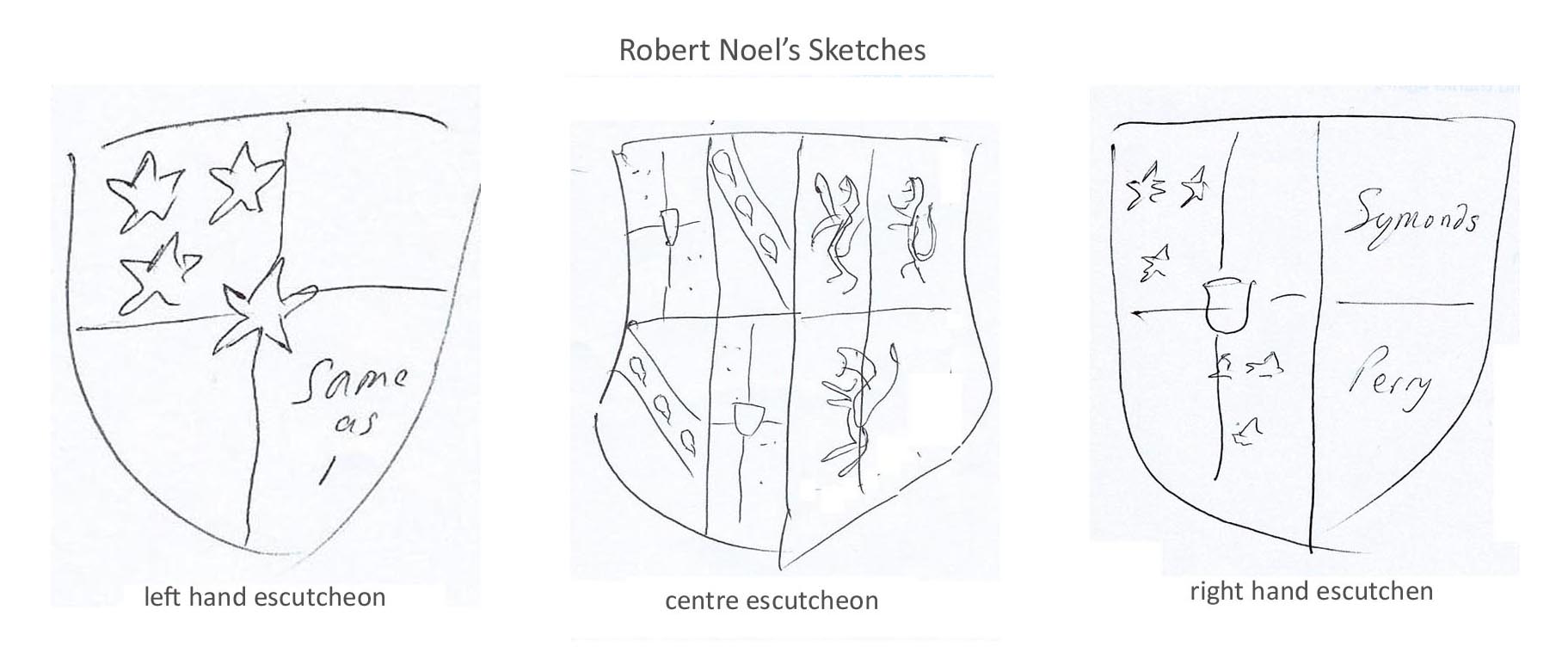
Noel sketched his interpretations as below:
At the base of the monument, a tablet is embedded in the black border. Unlike the monument itself, the tablet is cut from marble and is inscribed in Greek.
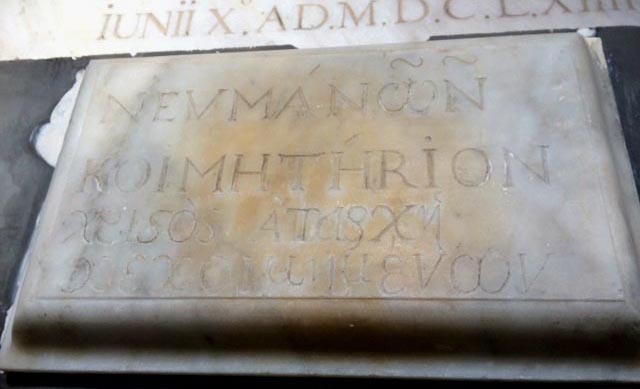
A rough translation of the text is as follows (courtesy of Eleni Fountoukidou):
Newman [second person plural]
Cemetry
Christ (or gold) beginning [a rarely used religious term]
Sleep or death
It might be inferred that it is saying that “this is the mausoleum of the Newmans where they lie in death” or words to that effect.
What is clear is that the tablet, like the alabaster escutcheon, does not belong to the monument. It may therefore be speculated that they both derive from an earlier monument to Richard Newman (d.1695) the chapel's builder, and that his monument was removed from the north wall to create space for the Cheere monument now affixed to it (see below).
Newman Chapel - North Wall: Sir Henry Cheere's Monument to Sir Richard Newman and Family
On the north wall of the chapel is a monument to Sir Richard Newman and his family sculpted by Sir Henry Cheere, a Westminster friend and neighbour of the Newman family who was famous in his day for his monuments in Westminster Abbey. The sculpture can be dated between June 1747 when Sir Samwell Newman died and January 1763 when Barbara Newman died - Sir Samwell's death being recorded in the original engraving whereas the date of Barbara's death was added later (see image below).
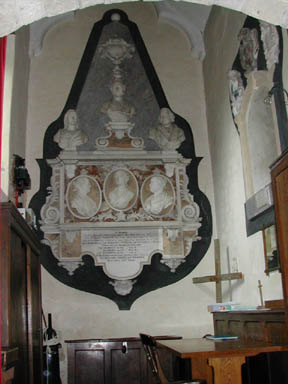
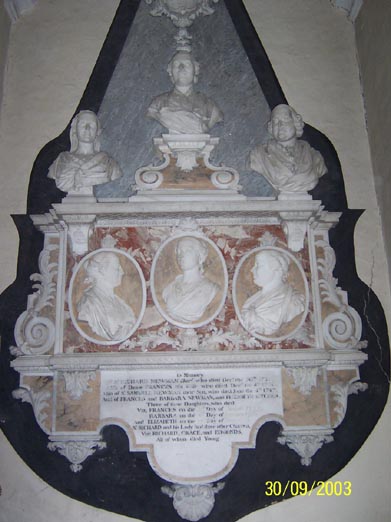
Sir Henry Cheere's Monument to Sir Richard Newman and family
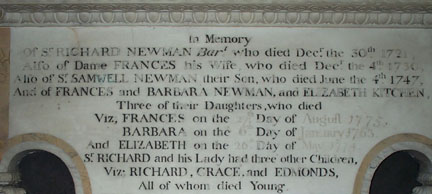
On a mural monument on the north wall of the same chapel, on a pediment (see photo below), are three well executed busts of Sir Richard, Sir Samwell and Lady Newman, and beneath them, three female heads in high relief of white statuary marble, which rises nearly to the roof of the chapel, and the arms of Newman properly quartered and blazoned, and underneath this description:
Churchyard: Gravestone for Thomas Newman:
Just inside the entrance gate to the churchyard at Fifehead, there is a large stone memorial dedicated to Thomas Newman. It is not known which Thomas Newman this was but it may hve been the eldest son of Thomas Newman of Fifehead (d.1649) or a son of Richard Newman (d.1664).
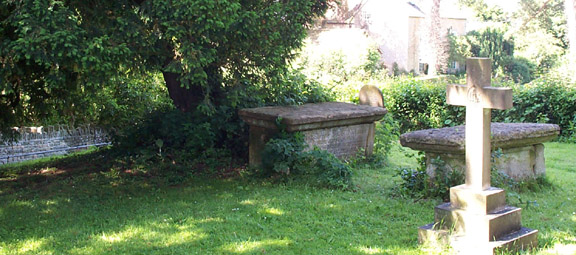
The following is taken from John Hutchin's History of Dorset:
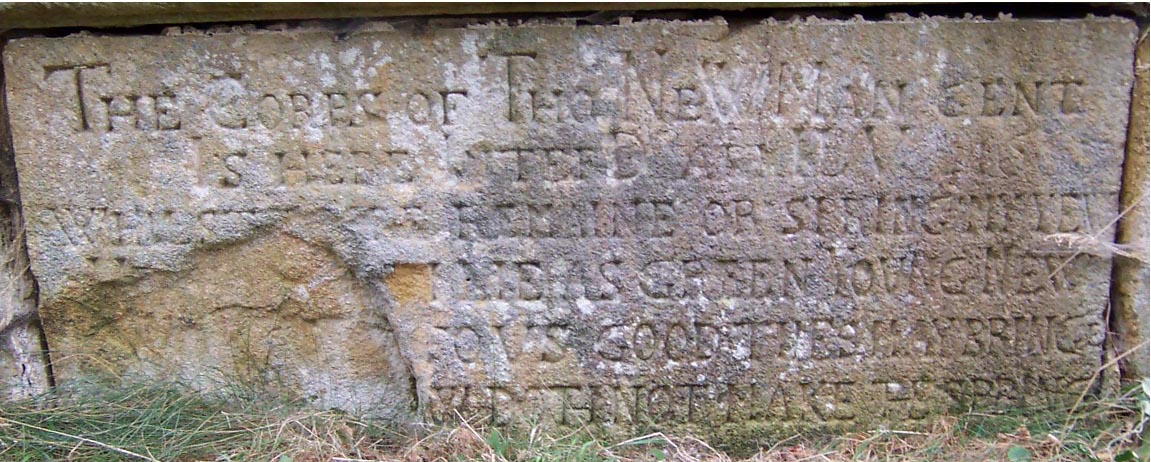
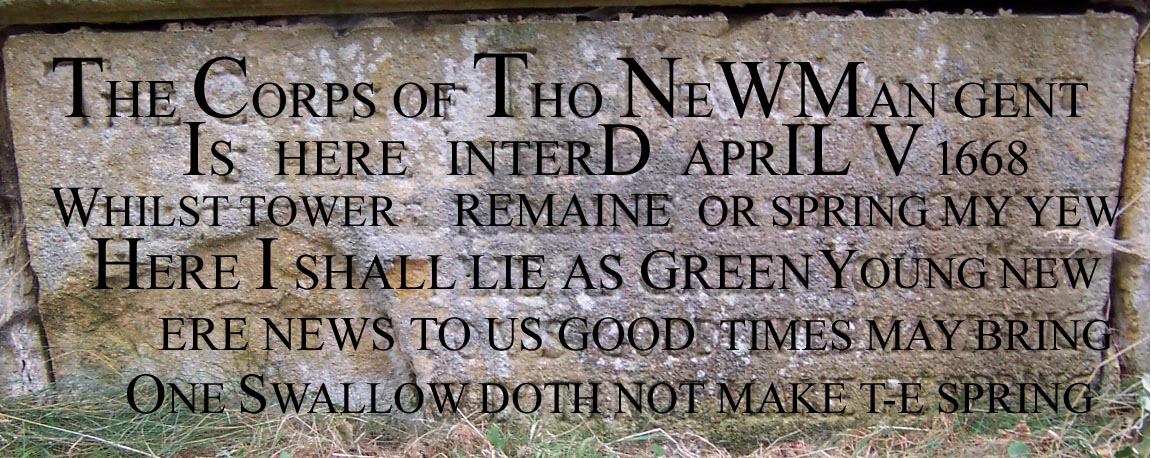
"The ancient burying place of the Newmans appears to have been under a large yew-tree in the churchyard [photo below], where there are some flat stones and two old tomb stones. Upon one, which stands near the church tower under the tree:
By 2003, the inscription had suffered significant weathering and surface damage over the 133 years since John Hutchins wrote his book. The date of 1668 was no longer legible though most of the rest of the text was clear enough and in general agreement with that given by John Hutchin, the only difference being that the word "SHALL" in the penultimate line should have been recorded as "MAY".
The images below show the inscription as it was in 2003 with and without the above text overlaid.