Frances Newman
c1702 - 1775
| Relationship to me: |
Second Cousin 6 Times Removed |
Gen -6 |
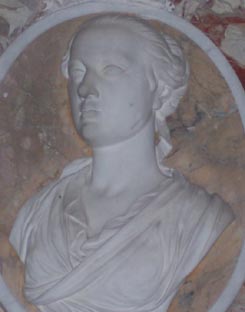
Bust of Frances Newman
in the Newman chapel at
Fifehead Magdalen (see note below)
|
| Born |
c1702 (deduced) |
|
| Died |
27th Aug 1775: Buried at Fifehead |
|
| Age |
~ 72 |
|
| Father: |
Sir Richard
Newman of Fifehead |
1675 - 1721 |
| Mother: |
Frances
Samwell |
d. 4 Dec 1730 |
| Brothers: |
(elder) Sir Samwell
Newman |
d. 1747 |
| |
Richard |
d. young |
| |
Edmonds |
d. young |
| Sisters: |
(elder) Grace |
d. young |
| |
(younger) Barbara |
b.<1712 d. 6 Jan 1763 |
| |
Elizabeth: m. Mr Kitchen |
b. >1712 d. 26 May 1774 |
| Married: |
never married |
|
| Children: |
none |
|
Notes - The large Newman memorial at Fifehead
displays the images of Frances and her two sisters Barbara and Elizabeth. I
have assumed that the central image (pictured above) as being that of Frances.
I don't have birth dates for Frances or her sisters, however Di
Clements quotes from Somerset Wills Sixth Series:
"1712 Sir Richd N of Fifehead
M Bart. Proved 1722 by Sir Samuel
Bart. To be buried at Fifehead. Monument not
to exceed £200. Estates to be sold to raise £5000 for Frances
eldest daughter and £3000 for Barbara. £60 for sister Toll. Codicil
daughter Elizabeth, born since will made, £3000. Sir RN to be buried
at Preston Deane Northants. The Trustees
either died or renounced."
From this we can deduce from the abstract that Elizabeth was born after the
date of the Will (1712, and that the other daughters were born before it).
Frances was the last "Newman of Fifehead", though it seems
likely that she spent most of her later days living in London. Her brother Sir
Samwell Newman had owned a residence in Old
Palace Yard in Westminster, London where he died in 1747 and this is where
his sisters lived after his death (as mentioned in the 1754 Act of Parliament mentioned below)
Frances's own Will begins with the words "Frances Newman of Old Palace
Yard Westminster" and the Will itself was registered in Westminster. However
Frances must have spent some time in Fifehead because Peter Oxlade records that: "Two
of Sir Samwell's three sisters continued to live at the Manor House and to control
the estate until the last one died in 1775". This is partially supported
by Gay Brennan who, in Dec 2014, wrote to say that she has a records showing
that Frances died on 25th August 1775 and was buried in Fifehead just two days
later, from which it can be deduced that she died there . Gay also reports that
Frances's sister Barbara was buried at Fifehead on 17 Jan 1763; however this
was 12 days after her death on 6 January 1763, so it is more likely that she
died in Westminster and that her body was taken to Fifehead for burial.
Frances was the last Fifehead Newman, because after her death (in 1775) the
Fifehead estate was sold in 1779.
Raymond Mercier has undertaken
the enormous task of transcribing Frances's
(16,000+ word) Will, commenting that:
"I have been transcribing the Will of Frances Newman, an incredibly
long and repetitive affair. She seems to be responsible for arranging so much
of the family fortunes from that time. .... The will uses the same long phrases
over & over again, paragraphs that are called boiler plates -enough here
to start a railway!" Raymond adds in a later email that "As to Frances'
estate, I can only add up the amounts that were distributed, which I make
£48,010, the ten being for the poor of Fifehead ! Poor indeed ! Goodness
knows what all the estates added up to. Millionaires, no doubt, by any standard".
One reason for the complexity of Frances's Will is that her elder brother
Sir Samwell Newman died intestate,
whereupon the administration of his estate was granted to Frances (see copy
of the extract for the
administration of his estate on Sir Samwell's
page). Frances never married and in her will she bequeathed a significant
portion of her considerable estate to Sir James Langham, bart. of Cottesbrooke.
However her principle heirs were her cousins, the males sons of Anne
Newman and Ashburnham Toll, who were required to adopt the surname and arms
of Newman.
The attached
version of Frances's will was sent to me by Gay Brennan who kindly corrected
several typos in the original transcription and inserted the text of two pages
that were missing from Raymond Mercier's transcription. I have added various
text colours and highlights to help me better understand the breakdown of her
inheritors and the amounts that they inherited (a work that is still
in progress).
I have also added a number of footnotes to the will giving details of several
of her inheritors and their relationship to Frances. These are listed in the
attached as-yet incomplete spreadsheet
summary. From this it seems clear that she limited her largess to her first
cousins (and first cousins once removed), her servants and executors, but left
nothing to her second cousins, the descendants of Francis
Holles Newman (my own ancestors). Given her desire for her inheritance to
be passed down to members of the Newman family (requiring her toll inheritors
to change their name to Newman), it begs the question as to why she left nothing
to her Newman cousins. Had there been a falling-out between the families? Did
Frances wash her hands of her Newman cousins? It would not be altogether surprising,
given what an argumentative and litigious bunch they had become by the time
of her death!
Elizabeth Newman m. Mr. Kitchen of Westminster,
Apothecary who died in June 1753 "without leaving any Issue by the said
Elizabeth Kitchin". In 1754 Parliament passed an Act authorizing the administration
of the estate of Elizabeth Kitchen"to make leases during her lunacy"
[from "History of Evercreech" compiled by the vicar, Rev. Preb. Jenkyns
c.1810]. A copy of that
Act was kindly sent to me by Raymond
Mercier. Interestingly it describes the house in Old Palace Yard, Westminster
(where it appears Sir Samwell lived at the time of his death and where his sisters
lived then and subsequently) as "in such decayed and ruinous state and
condition that it will be absolutely necessary to pull down, rebuild, or substantially
repair .... that no person will take a lease thereof without having a long term
of years granted for the said premises". One wonders whether to
put a literal interpretation on such a description (which presents the picture
of a rat-infested ruin), or whether to see it in relative terms - that it was
run down to the extent of being no longer suitable for gentle-folk to live in,
and in general need of refurbishment. The sisters do not seem to have been without
wealth, so it is hard to imagine them living in a slum (though, of course, such
things do happen!)
Updated 1 Feb 2016 - information added about the breakdown of Frances's
will.
Updated 26 Apr 2015
Page created 3 Dec 2003