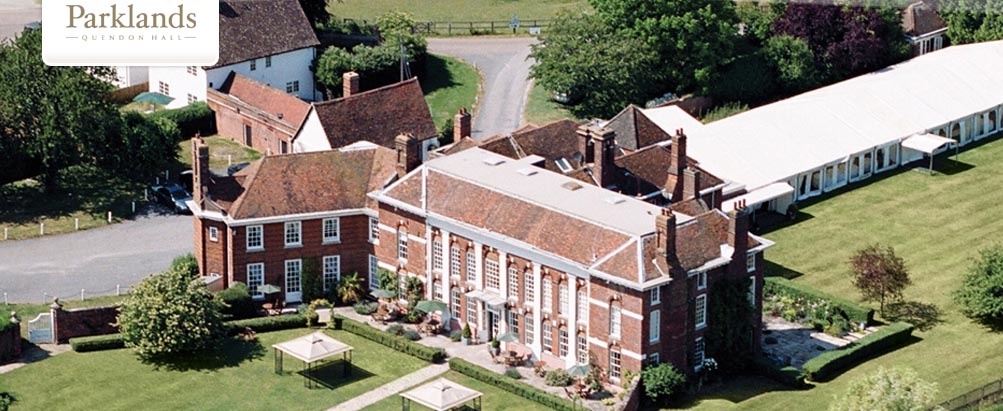
Quendon Hall, Essex - once named Newman
Hall after Thomas Newman who built the original house here c.1540. Most
of the existing house was built between 1670 and 1680.
See http://www.quendonpark.co.uk/88/the-history-of-quendon-hall
Odd references appear in obscure parts of the Newman family records of a connection to Newman Hall in Essex. The most notable reference appears on the memorial to a Thomas Newman (died 1649) on the wall of the Newman chapel in the church at Fifehead Magdalen, which is inscribed (in Latin) with the words “Thomas Newman is at rest beneath this altar, From the lineage of Newman [of Newman Hall, Essex]”. The words "de Newman Hall, Essex" have been inserted at a later date (see photo below). It is not known when or by whom the words were added.

According to the History of Quendon Hall (as Newman Hall is now named), it was built c.1540 by a Thomas Newman. Robert Newman's "Newman One Name Study" indicates that this Thomas Newman died in 1586 leaving Newman Hall to his only daughter Anne Wilford. Thus Newman Hall passed out of Newman possession in 1586, long before Thomas Newman of Fifehead's death in 1649, and longer still before his memorial was installed in the Newman chapel at Fifehead. Robert Newman's data shows that this Thomas Newman's father was also Thomas Newman, born c.1500. However the earliest appearance of the name Thomas in the Fifehead Newman pedigree is Thomas Newman of Fifehead Magdalen and Stoney Stoke c.1540 - 1574. It therefore seems entirely unlikely that the Newmans of Newman Hall in Essex were in any way connected to the Newmans of Fifehead.
Another reference to the Newmans of Essex appears in a sometimes misleading family history titled "The Newmans of Wessex" which states that: