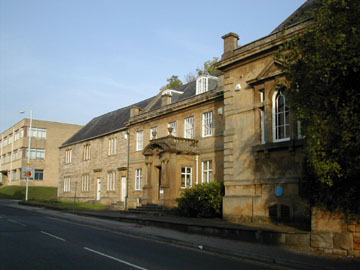
Hendford Manor - Yeovil office of Newman Paynter & Co
Hendford Manor - Yeovil office of Newman Paynter & Co
Introductory note:
For many years I laboured under a misapprehension that my g-g-grandfather Edwin Newman of Yeovil established his law firm in partnership with Francis Paynter of Penzance, another of my g-g-grandfathers. It appears however that this was not the case: the Paynter connection was not made until James Bernard Paynter joined the firm around 1881 shortly before Edwin Newman's death.
In a letter dated 13 May 1984, my father outlined his knowledge of his great-grandfather's law firm as follows:
"I have no chronology to accompany the tale of the solicitors' firm founded by my great-grandfather in Yeovil. Roughly what happened was that sometime before he died, he acquired a partner in Bernard Paynter from a Cornish family based in Marazion, a village a few miles east of Penzance. (It was in Bernard's era that I visited Hendford Manor several times. He had married a local girl, Josephine Bickton who bore him two sons, Camborne and Pendarvis - Cornish names par-excellance - who were several years my senior.)
Bernard's elder brother Henry married Edwin's only daughter, Henrietta. Why they elected to go to, or were banished to, remote Alnwick to set up a branch of the firm, heavan knows (perhaps), but it was there that they accumulated a family of 12, as with Edwin Newman a generation back, the fifth of whom was Lilian Jekyll, my mother.
The London branch of the firm was established by a Mr Gould when the firm became Newman Paynter & Gould. I can only guess that like other solicitors, house agents, building societies etc., it expanded with a view to boost profits.
My grandfather Walter was impecunious. Although educated at Rugby and the RMA Woolwich, I don't believe he received much financial help from the family afterwards. In any event, he could not afford to educated his two sons, Edwin and Walter, at Wellington. Edwin, the elder, qualified for Woolwich and became a Sapper, but my father failed to achieve a similar career because great-grandfather Edwin who had stumped up their school fees suffered a severe financial blow in 1880 due to his head clerk making off with the firm's funds, so that my father's school career was summarily curtailed. To qualify him for a career, he was articled to Henry Paynter's office in Alnwick where he fell for Lily. I know nothing about dates, but guess there must have been a gap between Wellington and the movement north in order to account for his unsuccessful wooing of the Miss Youle I mentioned in "Remeniscences". Anyhow, his articles completed, he was posted to Gould's office in The Strand and was taken into partnership around the turn of the century when the firm became Newman, Paynter, Gould and Newman (see below).
To complete the firm's story:- the Alnwick branch collapsed on Henry Paynter's death shortly after WW1. Then probably in the early '20s Gould retired and my father in the early '30s selected a young lawyer named Woolmer for partnership, retiring himself in 1937, aged 73. Woolmer was called up in WW2 when the Clements Inn office was abandoned and the branch absorbed into Messrs Denton, Hill and Burgin, now of Chancery Lane. When Bernard Paynter died, his partner Lovegrove carried on in Yeovil, abandoning Hendford Manor. Now he has retired and his business taken over by another Yeovil firm, Mayo & Co, making Newman Paynter & Co defunct."
Research suggests that some of my father's observations may not be entirely correct. For instance:
The following is believed to be a more complete account of the firm's history:
Establishment: According to research conducted by Bob Osborn, in June 1821 Edwin, then living at Babcary, entered into articles for a period of five years with James Parsons, attorney and solicitor of Somerton. Pigot's Directory of 1830 listed Edwin as an Attorney of Vicarage Street, and it was about this time that he started his own legal practice being listed in the same directory as a Yeovil solicitor, one of seven such firms in the town at this time. By 1832 Edwin, still living in Vicarage Street, had been placed on the electoral register by virtue of owning several newly built freehold properties in Belmont, Yeovil.
Around 1834, Edwin had amassed sufficient funds to move his family and his office to Hendford Manor, in Hendford, Yeovil, a quarter of a mile from his Belmont investments. Hendford Manor remained the headquarters of the family firm for at least the next 100 years.
Newman Lyons partnership: By 1839 Edwin was in partnership with Thomas Lyon (1814 – 1878), a London solicitor. Newman & Lyon continued in business until at least 1875 - most likely until Lyon’s death in 1878.
By the following year, Edwin had formed a new partnership with John Locke Jeans, the firm’s name of Newman, Jeans and Co. of Clements Inn London appearing in the 23 May 1879 edition of the London Gazette.
The 11 March 1881 edition of the Gazette includes reference to Newman, Jeans & Co. of Yeovil (i.e. of Hendford Manor). By then, Edwin’s eldest son Edwin, just 52 years old, had already retired from the law profession because of ill-health. (He died shortly after). Charles Octavius, Edwin’s only other surviving lawyer son was then 40 years old and living in London, so presumably he was employed in the firm’s London office.
The London Gazette of 6 Mar 1883 reported the dissolution of the Newman, Jeans & Co. partnership on the retirement of John Jeans on 18 Jan 1883, and stating that the business would continue to be carried on by partners:
Presumably the name of the firm then became Newman, Paynter and Gould as referred to in the London Gazette of 18 May 1883 which reported Edwin Newman acting as an executor for Emma Maria Alston. It appears again in the London Gazette of 10 May 1885 when the firm acted on behalf of the widow of an Albion Andrews.
The name Newman, Paynter and Gould appears again in the London Gazette of 16 Jun 1885, calling on creditors of "Edwin Newman late of Hendford Manor who died on or about 22nd Jan 1885", to send to Mr Frederick Gould full particulars of their claims. [The article includes reference to “an Order of the High Court of Justice, Chancery Division, made in an action in the matter of the estate of Edwin Newman, deceased, Newman vs. Newman, 1885, N., No 84” in relation to which creditors of Edwin Newman were requested to send full particulars of their claims.]
Later that year, the firm must have taken on a new partner since the London Gazette of 18 Dec 1885 records its name as Newman Paynter Gould and Williams. The Newman would have been Charles Newman who must have become senior partner in the London office, while Bernard Paynter took charge of the Yeovil office after purchased Hendford Manor from Edwin’s estate. This partnership continued until at least 1901 since the same name appears in the 12th July Gazette of that year. [Note - the firm was referred to as "Newman Paynter and Co., Yeovil Solicitors" in the 6 Jun 1899 issue of the Gazette.]
By then, another Newman had joined the firm, namely Edwin’s grandson Walter Ernest Newman (1864-1947). After finishing his articles under his uncle Henry Paynter in Alnwick, Walter moved to London and worked for the rest of his life from the firm’s London office. He later became a partner in the firm, perhaps in 1908 when the 9th June London Gazette listed the firm's name as Newman Paynter Gould and Newman. Charles must still have been the senior partner because the 1911 census records him as a solicitor aged 69 living in Chelsfield, Kent, an 18 mile commute from the city. [It is not known when Charles retired from the firm, nor when he died.]
The name of the firm may not always have reflected the names of the partners, since the firm continued to use the Paynter name long after Bernard Paynter's death in 1927, appearing in the London Gazette as late as 18 Oct 1938. Neither of Bernard's sons had followed him into the legal profession, and it is most improbable that any other Paynter might have taken over his partnership in the firm.
Likewise, by my father's account, Frederick Gould retired around 1920, yet the name Newman Paynter Gould and Newman appears regularly in the London Gazette up until 25 Mar 1930 (after which it appears as Newman Paynter & Co). It is however possible that Herbert Frederick Gould (Frederick's son?) might have become a partner since he was working out of the Yeovil office in 1938 according to the London Gazette of 18 Oct that year.
It is reported (probably by my father) that when Bernard died in 1927, he left Hendford Manor to his eldest son Camborne, who sold it to Yeovil Town Council in 1935, Bernard's partner, Mr. Lovegrove, taking over the firm’s Yeovil business. However according to the records of the London Gazette, Newman Paynter & Co continued to use 12 Hendford as its Yeovil address until 1952 when it moved up the road to 35 Hendford.
The London Gazette confirms that the firm made its final move to 10a Wine Street where it was still extant in 1980. According to my father, Lovegrove retired in 1984 and the firm was taken over by another Yeovil firm, Mayo & Co., rendering Newman Paynter & Co defunct, almost exactly 150 years after Edwin Newman first set up his business.
As to the London office, my father recorded that when Mr. Gould retired in the early 1920's, his father, Walter Newman, took over as senior partner there. Then in the early 1930s, Walter selected a young lawyer named Woolmer to join the firm, facilitating his own retirement in 1937. Woolmer was called up in WW2 whereupon the Clements Inn office was abandoned and the branch was absorbed into Messrs Denton, Hill & Burgin of Chancery Lane.
Note: It was my father’s belief that the "Alnwick branch of the firm" (as he believed it to be) collapsed on Henry Paynter's death in 1919. More likely it was the “Foster, Paynter” office that closed at that time.
Family notes:
At least three of Edwin's sons followed him into the legal profession: his eldest son Edwin (b. 1829), William (b. c1832) and Charles Octavius Newman (b.1841). Presumably all three were articled to the firm and at least one of them, Charles, was to become a partner working from the firm's London office.
At the time of the 1861 census, son Edwin was married and living in Mayfair. He remained in London for the rest of his life, retiring sometime before 1881 (according to the census of that year). It is not known if he became a partner in the firm, but he almost certainly worked out of its London office, his name appearing in the London census in the 1861, '71 and '81
Charles (who also lived in London) became a partner in the firm around the time of his father's death in 1885. Nothing is known about William's career or of his involvement in the firm, but his name is notably absent from Edwin's will, so it seems likely that he predeceased his father.
The connection between the Newman and Paynter families seems to have begun in 1856 when, in his "Story of Francis Paynter", Ian Caldwell records that the earliest connection that he can find between the was in February of that year when the Edwin and Francis worked together on a lease contract. Francis Paynter ran his own law firm in Penzance until his death in 1863.
The connection between the two families was cemented in 1867 when Francis's 4th son, 20 year old lawyer Henry Augustus Paynter married Edwin Newman's daughter Henrietta. The couple moved (or were banished) to Alnwick shortly after the wedding, and spent the rest of their lives there, Henry taking up a partnership with a local lawyer named Foster.
An even stronger tie was formed between the two families in 1876, when the recently widowed Edwin Newman married Catherine Augusta Paynter, widow of Francis Paynter. By so doing, Edwin (who had already fathered ten sons of his own) became step-father to five of Catherine's sons including his son-in-law Henry Paynter.
Out of this large collection of sons and step-sons, it is curious to note that two of Catherine's sons (Bernard and Henry, both solicitors) together with only one of Edwin's sons (Walter, a soldier) were appointed as executors of Edwin's estate. It seems odd that (lawyer) Charles Octavius Newman was not called to share this responsibility.
Finally, as described above, the link between the two familes continued with James Bernard Paynter joining Edwin's Yeovil office and by taking it over as senior partner following Edwin's death.
My father always believed that Edwin Newman retired from his firm in 1876 when he was presented with a mantelpiece clock by a grateful client. However the inscription on the clock does not mention retirement, saying only: "Presented to Edwin Newman Esq of Yeovil by the Four Sons of the Late John Valentine of Somerton in remembrance of much kindness shown to their father, November 1876" - see photos at right. It seems likely that Edwin continued as an active partner in the firm at least until 1883 and perhaps through to his death in 1885.
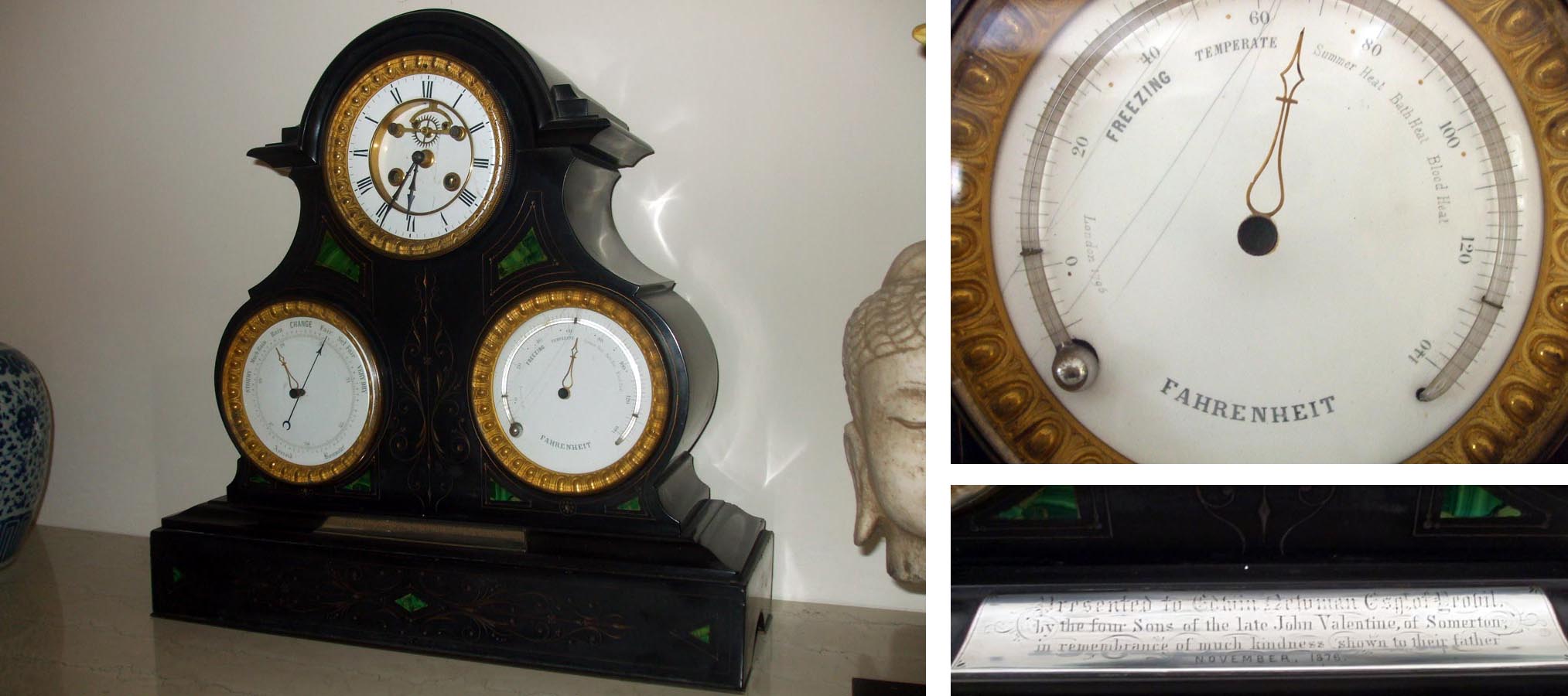
Edwin's mantelpiece clock.
On the face of the barometer is the inscription "London 1796" (top
right)
The plate inscription (bottom right) says:
"Presented to Edwin Newman Esq. of Yeovil.
by the four Sons of the late John Valentine of Somerton,
in rememberance of much kindness shown to their father
NOVEMBER, 1876.
"
Updates:
21 Dec 2014: complete rewrite
9 Jul 2013: Further text revisions and clarifications, including quotation
from Henry Newman's 1984 letter.
27 Mar 2012: text revised again throughout with information
gained from London Gazette
22 Mar 2012: text heavily revised.
9 Feb 2011: new photo added of Edwin Newman's clock
12 Jun 2009: New ideas added about the London office of the firm
11 Jul 2005: minor wording changes, links and photos added.
2nd Feb 05 - link to 1851 census added; clarification relating
to the note: "now of the Temple, London"