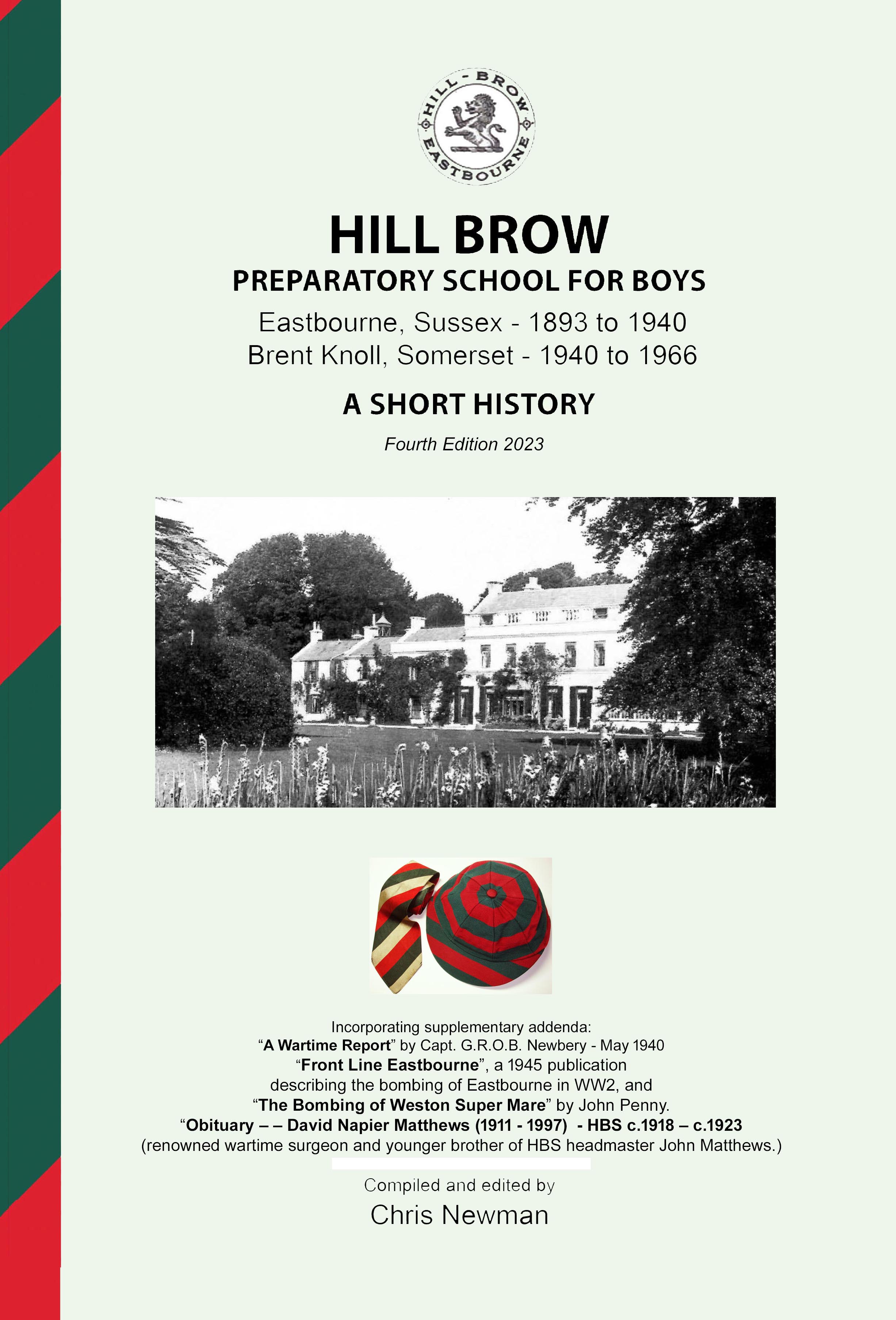
Hill Brow School - Brent Knoll
Preparatory School for Boys


This page is divided up into the following sections:

  5 -  The Teachers
  6 -  The Boys
  7 -  Uniforms
  8 -  Curriculum
 18 -  Reunions
 19 -  Obita Dictum
 20 -  More Photos

Note: If anyone can help correct errors or add photos, information or anecdotes to this page, I will be most grateful.


Somerset Court ~ c.2005

Introduction

So far as I know, no-one has yet established a website dedicated to Hill Brow School [see note below] that was once a feature in the village of Brent Knoll. I attended the school from 1954 to 1959, and whilst I didn't love the place, it formed an important part of my life and offered me as good an educational foundation as I would probably have got anywhere at the time. Certainly in terms of examination performance, I never again achieved the grades that I managed to attain from my Common Entrance exams taken at Hill Brow.

In 2009 I was contacted by two ex-pupils of Hill Brow who happened to find mention of the school on my family-tree website: Christopher Butt, who attended the school from c1946 to 1951, and Peter Isaac who was a contemporary of mine at the school (1956 to 1960). It was their communications that prompted me to create these pages, to which they have contributed with both knowledge and memories that extend beyond my own. Since then I have been in touch with several other alumni of the school (through Friends Reunited) who have contributed recollections of their own.

I offer these pages on Hill Brow in the hope that other pupils of the school will discover them and contribute their knowledge and anecdotes to this page. Hopefully, it might inspire someone to create a website dedicated to the school and to the people that it brought together over the years of its existence.

I begin by offering an incisive observation about old-style prep schools from Peter Isaac who writes:

"Hill Brow School prior to 1960 presents a snapshot of a now disappeared era of England and Empire. People in the Commonwealth and even in the UK itself do not understand that in the heyday of what is known as "the Public School era", it was, in fact, the Prep School that mattered. It was here that accents and attitudes for good or ill were formed. Indeed, it was the Prep School that determined if you were going to get into Public School in the first place... After 1960 everything changed. In came the county children, the girls, and of course masses of state surveillance and thus compliance."

Note: Since establishing this page, Peter Isaac has launched a page on Hill Brow Preparatory School for Boys on Wikipedia.

Back to menu

Background and History

Hill Brow School appears to have been founded in Eastbourne in the early 1930s by an R.G. (Rowland?) Thornton M.A. whose large photo portrait stood over the stove and mantelpiece in the main classroom in its Brent Knoll days, the same classrooms being hung with school photos dating back to that period. This information is supported by information supplied to Christopher Butt by Jonathan Seaman, Museum Officer at the Redoubt Fortress and Military Museum in Eastbourne who wrote to say that:

"Hill Brow first appears as a school in the Gowland’s Eastbourne Postal & Borough Directory of 1936 and has R.G.Thornton MA., JP & F.J. Matthews MA registered as principals. The last directory we have at present is dated 1940 and the school appears in this, as above. It may be that the school occupied the former St Christopher’s School, which stood on the corner of Denton and Gaudick Roads." (See email correspondence between Chris Butt and myself dated 6th to 19th Dec 2009. In this correspondence, Jonathan Seaman initially refers to finding this information in Kelly's directory.)

There was never any hint given to us boys that the school might have had an earlier history than Eastbourne, however there was a "Hillbrow" boys' preparatory school located in Rugby in the late 19th century that was attened by Rupert Brooke and James Strachey. Since there appears to be no known link between the Rugby and Eastbourne schools, references to the Rugby school are discussed on a separate page. Kelly's Directory of Hertfordshire for 1908 shows a “Hill Brow School for girls, describing it as a "small home school particularly adapted for children whose parents are abroad”. It might also be presumed that there was no connection between it and the Eastbourne boys' establishment.

Hill Brow School moved to Brent Knoll sometime early in World War 2, after Eastbourne became a target for German bombers. A Wikipedia article (http://en.wikipedia.org/wiki/Meads#column-one) includes a statement that "at about 5.30pm on Friday 16 August 1940, the first German aircraft to be brought down within what was then the County Borough of Eastbourne crashed in Meads. .... The German aircraft broke up in the air, and the pilot, Hauptmann Ernst Hollekamp, was killed when he fell on the roof of Hillbrow School in Gaudick Road, his parachute unopened." There is a photo-postcard of the event (copied below) and a website showing newspaper photos of bomb damage to the town.

Damage to Hill Brow School, Eastbourne, caused by German pilot falling through roof when his parachute failed.(body being removed)

The name "Hillbrow" has been preserved by the University of Brighton which offers a Hillbrow Campus at 1 Denton Road at its junction with Gaudick Road (see satellite photo below). Given Jonathan Seaman's information above, it may be concluded that this is the location of the school in its pre-war years.

Peter Isaac recalls that several Hill Brow boys fought in World War 2, as attested by the "Dennis Mayne Library", a single bookcase in the Form IIIa classroom (between the main assembly area and the entrance hall. (Mayne was killed in the War). Peter also recalls that on one occasion, the headmaster John Matthews showed a collection of super 8 films, and commented that many of the boys seen in them had been killed in the War.

It is nor known when John (F. J. H.) Matthews took over as headmaster, but the evidence above shows that he was joint principle as early as 1936. Indeed, Nicholas Sanceau reports that Matthews (and "Bugs" Newberry) taught his father who was head-boy at the school in 1935. Derek Hoare has confirmed that John Matthews was headmaster when he first attended the school in 1943 (when there were 43 boys at the school). In the absence of further evidence, it seems likely that John Matthews might have taken over the school when it moved from Eastbourne to Brent Knoll sometime around 1940.

Back to menu

Somerset Court

As recorded elsewhere on this website, Somerset Court's claim to fame was its association with Judge Jeffries who held his assizes there to prosecute supposed supporters of the Monmouth Rebellion against King James II in 1685. According to legend the guilty (as all accused would no doubt have been found to be) were taken directly from the courthouse and along what is now Harp Road up to the crossroads at the Fox & Goose Inn where they were duly hanged. I think the crossroads may have had a name associated with the hangings, but I have now forgotten it.

The location of Somerset Court is shown on the "active" Google Map below:


View Somerset Court, Brent Knoll in a larger map

Nicholas Sanceau believes that John Matthews leased the Somerset Court premises from "a pair of elderly sisters", but has no information as to who they might have been. At any rate, Hill Brow School was well established in Somerset Court by the time I arrived in 1954, as it was in Chris Butt's day (1951).

School Grounds and Buildings

During my time at Hill Brow, Somerset Court was much the same as it appears (outwardly) today - a cream painted stucco-walled three-story building surrounded by lush grounds that featured a beautiful cedar tree that dominated the large south-facing lawn, beyond which were some gardens and a small pond called "the moat". The lawn was decked out with four or five cricket nets over the summer months (see photo below), and a tennis court (net just visible perhaps on the right), and was kept in pristine condition by John Matthews himself who took sole responsibility for mowing it, being regularly seen sitting on a seat mounted above the roller attached to the rear of an enormous Dennis motor-mower.


Hill Brow School / Somerset Court c.1958

To the east of the main building were kitchen gardens looked after by a gardner (George Blaber) which/who supplied the kitchens with fresh vegetables to feed staff and pupils. To the east of the building was a triangular shaped fenced-off enclosure of grass and saplings surrounded by gravel roads. On the right hand-hand (northern) side was the main entrance road to the school. On the left (south-eastern) side, the road ran past a small wooden lock-up that contained the sports equipment (footballs, cricket gear or hockey sticks, according to season), beyond which were a series of outbuildings that included a bicycle shed (where day-boys could park their bikes), a carpentry workshop, and a shooting range where boys were allowed (under supervision) to fire air rifles at targets, graduating to .22 rifles as they got older. There was also a boxing ring where George Blaber ("Blubbs"), the handyman-gardner, was in charge of coaching. Peter Isaac recalls that in earlier life, George had been light heavyweight champion in the British Army, and a horse-handler ("wrangler") in the First World War.

Somerset Court 2009 (courtesy Google Earth)

Beyond the western side of the triangle were the playing field - an expanse of grass large enough for two-and-a-half cricket field in summer, and two(?) soccer/hockey pitches in the Christmas/Spring terms, pupils being assigned to each according to age and skill. Around 1958, "rugger" was added to the sporting curriculum for the older boys. In the far SW corner of the field, a cricket pavilion was built in 1955 (or thereabouts) as a donation from the cricket-loving father of John Dunford. Peter Isaac recalls that the pavilion was built by the father of Philip Legg, the only boy that he can recall ever being brave enough to run away from the school.

In the late 1970s the corner of the playing field was cut off by construction of the M5 motorway, but the pavilion still stands and Google Earth shows that there remains a cricket pitch in front of it (see above).

On the north side of the main building was an entrance porch protruding into a gravel turning circle on which an elegant Daimler car would stand, the proud possession of John Matthews. I recall a black model (probably pre-war) with a handsome sloping rear that was replaced in 1955 or 56 with a more modern but (to me) less attractive maroon model of post-war vintage. Both cars were a step up from the Wolsley 1500 that Matthews had in Christopher Butt's day which he describes as being able to reach 60mph with a following wind on the A38.

At the end of the entrance road forming the northern side of the "triangle", was (and is) a small gate-house which was occupied by a Mrs. Solomon, the music teacher who also looked after the junior 'Form IV' class. Years later, she was to become my step-mother, Babs. It was in this gate-house that I sat (alone, with an invigilator) my Common Entrance exams in late 1959.

The main school building appears to have been constructed in four (or more) separate sections (see plan layout below). The main section, probably the oldest, has three stories (see photo above). In my time, the ground floor rooms on the south side were: inside the two French windows (on the left of the main building in the photo above) was the headmaster's study; inside the central casement window and the next two French windows next to the conservatory (on the right side in the picture) was the dining room. Beyond these on the north side, were the main entrance hall on one side of which was a carpeted staircase with with its braided velvet rope handrails that led up to the headmaster's living rooms - woe-betide any boy found using it! To the other side, facing the driveway, was the 'Form IIIa' classroom - Form IIIa being a mid-level class between Form IIIb and Form II. On the 1st floor (2nd floor outside the UK) were boarders' dormitories and a I think a sick-room and two boys' bathrooms, where the boys were given compulsory haircuts once per month. Above them on the 2nd floor (3rd floor outside the UK) was, I think, the headmasters' bedroom(s).

The outline of the above plan has been scaled from a Google Earth photo of the school building. I have done my best to sketch inside it the layout of rooms and their contents as I remember them - including the (individual) desks and bench seats in the Forms 1 and 2 Assembly Area. I suspect the scaling is not right, because I've not been able to fit seats for 60 boys into the available area.

On the eastern side (to the right of the above photo and plan) was a separate wing which might have been called the Annex, or perhaps that was the name given to the conservatory which housed Mrs Solomon's 'Form IV' class. Behind the conservatory was the main assembly room where the whole school (50+ boys) gathered at 8:30 in the mornings for Bible reading and prayers at 9:00am, and again after lunch for the issue of sweets (handed out on a tray) and a period of rest. A sliding system of folding doors was pulled across the centre of the room to divide it into two classrooms - Form II on the Southern side next to the conservatory, and the smaller Form I on the northern side looking out over the Daimler and the gravel turning circle. Above these, on the first (second) floor, was the headmaster's living room where on very rare and special occasions, boarders might be invited to watch a TV show. Peter Isaac (who was a boarder from the time he joined the school in 1955) recalls the privilege as a "long-service honour", and remembers going there once a week for several years to watch David Nixon the conjuror, and Eamonn Andrews’ "What’s My Line". Mrs Matthews would hand around nibbles. David Potter (two or three years earlier) recalls being allowed to watch Sergeant Bilko programs.

The western end of the main building (to the left of the above photo and plan) consisted of another two-story wing. On the ground (1st) floor immediately adjacent to the main building was the boys' entrance, inside which were rows of hooks to hang rain coats and a bench under which were slots where outdoor shoes were placed on arrival each morning for George Blaber to clean and polish, only 'indoor shoes' being allowed inside the school. Next door (towards the west) was the kitchen where Syd and May used to prepare lunches for the whole school, as well as breakfast and dinner for the boarders. Sometimes they were assisted by two"Italian maids" who presumably came over as seasonal workers (one of whom I thought very beautiful and fell madly, but secretly, in love with.) Next there was a narrow dark uncarpeted back-staircase that was used by boys and servants to access the dormitories. Peter Isaac recalls that George Blaber had to struggle up these stairs with each boy's heavy trunk because he wasn't allowed to use the main stairs.

On the extreme western end of the ground (1st) floor was the masters' common room, on the far (northern) side of which were the boys' toilets and changing room which included a shallow in-floor pool where smelly feet were washed after sports. There were no showers so sweaty bodies were not washed (nakedness not being encouraged).

Talking of washing, boarders were allocated two baths per week - Mondays and Thursdays, Tuesdays and Fridays, or Wednesdays and Saturdays, if I remember correctly. I don't recall what happened on Sundays in terms of bathing. Probably nothing.

Opposite the kitchen on the northern side was the Form IIIb classroom. Upstairs must have been more dormitories because that is where the back stairs led to, but I don't remember much about the upstairs layout. I do however recall a small sewing room that was occupied by Mrs O'Neill, a small elderly widow who lived at Edithmead, and who my mother knew (hence I regarded her as a friend and ally!)

Christopher Butt has unearthed a postcard photograph (below) of Somerset Court that must have been taken around the start of the 20th century. It is interesting to see that the only change visible in the building between then and the mid-1950s was the absense of the upper floor over the eastern extension (the end nearest the camera) which John Matthews used as his living room. What the building was then used for at the time of this photo is unknown. :

Somerset Court c.1900

Back to menu

The Teachers:

In my day there were five permanent teachers at the school:.

All were teaching in the school during Chris Butt's time there (1946 to 51) and both Matthews and Newberry taught Nick Sanceau's father who was head-boy at Eastbourne in 1935.

Matthie was not a humourous man, and adopted an attitude of serious detachment appropriate to his role as headmaster. He presided over prayers and Bible readings each morning, and took most or all classes for French and Scripture lessons.

Bugs (Major Newberry) took some pains to display a laid-back sense of humour that could evaporate quickly if he was crossed. He smoked profusely and had the most discoloured fingers that I have ever set eyes on. He enjoyed inventing nick-names for certain boys - mine being Noggs (presumably from the Dickens character Newman Noggs, though he told a different story at the time). 56 was his favourite number, and every boy in his class was expected to remember on an instant that 7 x 8 = 56 (as I will never fail to do).

Bugs maintained the title of "Major" and delighted in telling war stories, especially (in my recollection) one relating to Japenese POW's swallowing cyanide pills. I always (therefore) assumed that he was a career soldier until Nick Sanceau reported that he taught his father at Hill Brow in 1935.

Jimmy Sergeant was a batchelor and in my mother's view a mysogenist - a word that I had never heard before she used it to describe him. I cannot imagine that she really meant it, because in my recollection he was a lovely man with a soft heart secreted behind a hard and forbidding exterior. He was the best math and Latin teacher I ever had and I missed him greatly after leaving Hill Brow.

Bill Mayo (ex Royal Navy) was slightly less likeable, having a short temper and taught less interesting subjects (as I saw them) and/or had less teaching ability. He was the principal geography teacher and also introduced pupils (as I recall) to the terrors of Latin - subsequently enjoyed rather more under Jimmy Sergeant.

Mrs. Solomon was responsible for the junior Form IV class. She also took music (singing) lessons for all Forms and gave piano lessons to individual boys who either displayed talent or (more likely) whose parents paid extra for them.

In addition, temporary teachers were engaged often for a year or less - all young men, probably graduates or taking a "gap year". These included Ian Schalberg and a Mr. Kennedy who, according to Peter Isaac, would wander the back of the class administering what he described as Paddy Gaulls - a kind of medium intensity rabbit punch delivered to the back of the head.. Another was an old boy called Rigg, known as Rigg the Prigg, who Peter remembers as "the only all around truly unpleasant staff member I can recall", a recollection shared by Nick Sanceau.

The temporary teacher that I best remember (as does Richard Synge) was Chris Brown who drove an open-topped Austin 7 and walked with a slight limp. As I recall he was at the school for two years during my time there, and seemed a rather "modern" and urbane compared to the older teachers.

Another itinerant was the bearded Mr Norris who taught art on a part-time basis in the conservatory on a Monday (as Peter Isaac recalls). He also remembers somone called Redman "who spoke in a much imitated Shakespearean west country brogue."

Back to menu

The Boys:

The school had space for around 60 boys - numbers varying from around 50 in 1954 to over 60 in 1959. (Derek Hoare reports 45 pupils when he joined the school in 1943.) In my time around half were boarders, most of whom slept in the dormitories within the main building. However ten or twelve senior boys were 'privileged' to be housed in a couple of dormitories across the road in Chelsea Farm where Bugs (Major Newberry) lived.

Full sized school photos dating from 1951 to 1959 can be seen by clicking on the thumbnails below. Assistance in naming the faces in the photos will be welcome:

Back to menu

Uniforms

The school colours were red and green. The colours were displayed on school caps (with horizontal rings of alternating colours), school blazers (with vertical stripes of alternating colours) and ties (with diagonal stripes of alternating colours). Grey shirts, grey flannel trousers, grey socks and black shoes completed the uniform. Short trousers were worn by junior boys summer and winter. Seniors graduated to long trousers around the age of 12 - a great privilege as it seemed! Trousers were held up with a red and green (horizontal) striped belt with a silver-coloured S-shaped buckle styled as a "snake".

Boys who excelled at sports were awarded "school colours" which permitted them to proudly wear a green cap with a lion crest on the front (as displayed on the Cricket XI photo above).

Nick Sanceau reports that he has inherited his father's Old Hill Brovian tie with red, green and silver diagonal stripes, but I recall no such ornaments being offered in my day.

Back to menu

Curriculum and Classes

As mentioned above, there were five classes in the school, student graduating from one to the next each year. The classes (or "forms") were numbered as follows; the age allocation of boys is a rough indication only:

Each class was allocated its own room where boys would remain while teachers moved from classroom to classroom according to the timetable.

The school curriculum was quite limited but being such a small school class sizes were small, so boys got close attention from their teachers. Classes seldom had more than 12 boys, and in my last year in Form I, there were only four boys.

As I recall, the curriculum was split up roughly as follows:

I find it hard to judge the quality of teaching at the school. I doubt that many (any) of the teachers were formally trained. I recall that "rote" teaching was a method favoured for both maths ("times tables") and history (dates of Kings and Queens), and this worked well for me (and still does). The most inspired teacher on the team was Mr Sergeant who terrified me in my early days, but who I discovered to be both warm-hearted and good humoured as I got older and knew him better. I never had a math teacher who compared with him after I left Hill Brow and I still remember (with fondness) many of the algebraic equations that he drummed into my head.

Oddly enough I was never given any homework in the whole time I was at the school. I suspect this was a policy of Mr Matthews that was aimed at giving the boys (and/or the teachers) more free time after school. Notwithstanding, the school produced good academic results and certainly I attained better scores from my Common Entrance exams than I managed in my subsequent school career.

Back to menu

Extra-Curricula Activities

There were several extra-curricula activities offered by the school - most being optional, and some having been mentioned elsewhere on this page. Three that I recall took place in the out-buildings between the main building and the sports field:

In addition, piano lessons were offered by Mrs. Solomon and Mrs. Matthews.

Peter Isaac remembers "Nature Studies" and Nick Sanseau reports that in his time, John Matthews "started a Gardening Club, with plots allocated to us in the field behind the pond behind the lawn and cedar tree. We all grew radishes and spring onions which went towards our midnight feasts......".

Christopher Butt recalls being taken to horse riding lessons in Burnham-on-Sea (which I don't recall being offered in the mid-late-50s).

Back to menu

Food and Meals

Strict rules applied to both foods and meals. Meals were eaten in the dining room where each boy was assigned his own seat at a table which he shared with his classmates, with his form master seated at the head of the table. Each boy was required to have his own silver knapkin ring in which a starched white rolled-up napkin would be kept. Before each meal, grace would be said by the headmaster who sat at the head table - "For what we are about to receive, may the Lord make us truly thankful.". Food was cooked in the kitchen by Syd and May and brought to the tables either by them or by the servants working under them. (Was it dished out onto plates in the dining room, or brought in on plates?)

Breakfast (for boarders) consisted of cereals or porridge, eggs & bacon, toast and marmalade or jam. Lunch (for everyone) was a fulsome two course affair as was dinner (for boarders only). Food quality was generally very good and helpings were more than adequate. Ice cream was a great treat, as (I recall) was peanut butter. Some thought May's jelly-trifle a treat, but I for one loathed it. Boys were required to eat everything that was put on their plates whether they liked it or not. I recall baulking at a large piece of what looked like animal skin that happened to be on my plate and being severely reprimanded because I refused to eat it. Nick Sanceau has a similar recollection, and further he recalls that "school stews were not very palatable. We used to secrete the fat and gristle in our hankies and empty the offending articles in the upstairs loos when we changed for games in the dormitories. In my day, Sunday lunch was ALWAYS very watery and fatty roast pork (never any crackling), and, for supper on that day, ALWAYS pilchards in tomato sauce accompanied by un-vinegared beetroot. Yuk..... However, the bacon and fried bread, and the syrup we could spread on bread and butter at that meal, was splendid!"

In addition to the large meals, milk and currant buns were issued at break-time each morning and afternoon. Again, their consumption was compulsory which presented me with serious problems because there was (apart from rice pudding) nothing I loathed more than currant buns. I recall going to endless difficulties each day trying to get rid of my bun - either by giving it to someone else, or stuffing it into my desk or my pocket. Any such manoeuvres were regarded as a serious offense if discovered. In the end, my mother sent a note to school asking that I be given buns without currents which gave me enormous relief!

Boys were allowed to bring sweets to school but were not allowed to keep them. They had to be handed over to the duty-teacher on arrival in the morning, and they would be combined and spread out on a tray to be handed around the assembled boys during the after-lunch rest time. Being caught with sweets that had not been handed in for sharing, was a very serious offense.

Back to menu

Entertainment

At the end of each term, boys would be entertained with a movie - or usually two movies, the first being a cartoon - usually Micky Mouse, Donald Duck or Popeye the Sailor Man - which were always very popular. The main movies were typical of the day and I particularly recall "The Dam Busters", made in 1954 starring Richard Todd and Michael Redgrave. I remember many other great movies from that period, like the Lady Killers, Genevieve, and Doctor in the House, but don't recall whether I saw them at school or in the cinema. Peter Isaac recalls seeing "Sanders of the River", "Battle of the River Plate", and (interminably) the "Disney Living Desert".

Once a year (or maybe twice) a lecturer would come and give a talk, some of which were boring but others that were quite entertaining. However I no longer remember the speakers or their topics. Peter Isaac recalls that: "a Mr Sewell the conjuror was best. He would distribute paraphernalia to all his stooges. Then there was the fellow from Exmoor with all the antlers in canvas gunny bags. There was a fellow who would lecture on the Empire/Commonwealth “Morl-ta – Gibber-er-alta, and what is it boys? Cyprus!" There was another lecturer who specialized in aircraft. He asked the boys to identify a certain aircraft, a Comet, I think. “It’s a BOAC,” yelled out Perris, to much subsequent ragging.

"A big thing was the Oxford & Cambridge Boat Race which was relayed via the 1920s era wood-and-cloth framed wireless triangulated into the wall above the duty masters desk.

"There was another once a year 'event'. This would take the form of a dance where we would dance with one another if one was not dancing with one of Ian Cox’s sisters, one of whom was called Theresa (the elder one was Deborah). On other occasions there would be a kind of fairground episode with the teachers holding various stalls. This required the boys to spend the entire afternoon in the dormitories, on their beds, prior to the event."

Another once-a-year entertainment took place every 5th November to celebrate Guy Fawkes night. A huge pile of dried tree limbs and branches would be piled up in advance at the side of the Sports Field adjacent to the roadway at the western side of the Triangle, with an effigy of the malefactor placed on top. Then sometime after dark on 5th November boys (and parents who came along) were entertained by a display of fireworks set-off by the teachers, ending with the lighting of the huge bonfire (huge, at any rate, in the eyes of small boys).

Of a rather different form of entertainment, Christopher Butt recalls that Major Newberry (Bug) “had a .38 revolver from WW1 which he kept in an outhouse at the farm. This kept us amused quite often”. It reminds me how Bug enjoyed reliving his war experiences by entertaining the boys with stories about them. I especially recall him telling us a story of a German or Japanese prisoner under his control committing suicide by swallowing a cyanide pill and turning green from the effects (though I may remember the colour wrong). He delighted in telling us those sorts of stories, and of course we (being boys) loved hearing them. I recall too that in his history lessons he liked to dwell on the hangings, beheadings, burnings and disembowlings that help make British history so entertaining for boys.

"Self-entertainment" was offered in the form of a table tennis table which was stored (folded) against the back wall of the Conservatory and which was allowed to be used in what free time we were allowed. There was also a billiards table that boys were allowed to use. Christopher Butt recalls it being located in the Form 2 classroom against the dining room wall, however by 1954 it had been moved to the back of the Form 3a classroom. This is where Peter Isaac remembers there being "the Dennis Mayne library" in a bookcase which I think must have been along the wall between the classroom and the hallway, Dennis Mayne being a Hill Brow boy who was killed in WW2. Anyway, I recall that access to the billiard table being quite heavily policed and play being monitored by a teacher to ensure that the felt surface didn't get damaged by careless use of a cue.

Another entertainment that I recall was being invited to play chess in the evenings (during my boarding years) with Jimmy Sergeant. There must have been an enforced resting period after dinner where boys would sit in the main Forms 1 & 2 assembly area under the supervision of a teacher. When it was James's turn, he would often invite a senior boy to come to the teacher's table and play chess with him - always setting himself a handicap by removing his queen.

Back to menu

Coming & Going

My parents lived in Bason Bridge, about 3 miles from the school. In my "day-boy days" (1954 to 1957), my mother used to drive me to school in the mornings. She led a busy life on the farm so quite often she was late which was a source of intense anguish for me since I had to present myself to the "duty master" in front of the whole school to explain why I was late. In my first year or two, she made an arrangement with Michael Herrings's parents to collect me in their taxi (they ran a bus and taxi business) and to deliver me to Highbridge Station from where I would take the train home to Bason Bridge. Happy days they were, because quite frequently I would get a ride home in the engine (see the S&D section of this website).

Subsequently my mother used to collect me from school in the evenings, when I joined the other day-boys who would wait unsupervised (unbelieveable looking back, in view of the strict controls imposed during the school day) at the near corner of the "triangle". In winter time, it was dark by the time school ended (around 5:30pm) so the bigger boys would often take the opportunity to terrify younger ones by making ghost noises from behind bushes. Cruel, but funny to juvenile minds!

By 1956 I was old enough to buy a half-decent bike on which I used to cycle to school regularly. By that time I was starting to find the strict regime at Hill Brow a bit stifling so I relished the freedom of being able to walk out of the school at the end of the day and cycle away on my own. That freedom was curtailed the following year when I became a weekly boarder. I well remember arriving at school on my first day as a boarder and having my bike impounded. This I resented deeply. Why was it OK to ride my bike after school when I was day boy but not now that I was a boarder? It didn't seem fair to my innocent mind.

Peter Isaac recalls John Matthews being "what we know now as a control freak. He wanted everyone and everything where he could see them. At half term he insisted on specifying the hotel and general environs in which his charges could be taken by their parents!"

Peter also reminds me that "when a boy left, there was a ceremony in Matthews' study in which he gave the leaver a book, always selected thoughtfully, and wished him God's speed and gave him a steer or two in relation to the future and the leaver's character as he had observed it. This was done in some detail, as was his way. As I left his office for the last time, I noticed a rather seedy character sitting in the alcove to the left as one looked out into the driveway. Matthews followed me out. He walked up to the character in the alcove (whom he had obviously left cooling his heels for at least half an hour) and said 'Ah, are you the reporter from the Bridgwater newspaper?' 'I hope I never go into that business', I thought to myself, having witnessed Matthews's somewhat lordly treatment of the fellow!" (But of course, that's precisely what Peter ended up doing.)

I too recall the “facts of life” chat that Mr. Matthews bestowed on me when it was my turn to leave the schoo, and I remember being disappointed that he was so circumspect about it after been led to expect revelations of dark and mysterious secrets. He spent more time reassuring me that Rugby was not such a dangerous game, and that whilst players might suffer more minor injuries in Rugby than in soccer, they suffered more major injuries from playing soccer than Rugby. I doubted the truth of it then and still do! Nick Sanseau recalls that his sex education consisted of being told "not to compare notes" with Senior Boys if asked, ordered or invited by thembut that in those days of innocence he didn't really know what he meant!

By contrast Christopher Butt reckons Peter and I were lucky to have had dancing and sex education since he had to wait another three years. On the other hand he recalls that "the walk to the Church on Sundays was usually good fun", and that on one occasion "the church visit was curtailed on arrival; the rumour was that someone had just leapt off the roof." Christopher also reminds me of "one house on the right hand side of the road always had a 'penny-farthing' bicycle outside that was occasionally ridden". This was (or became) the "Ordinary Club" and I recall that in the 1960s the sight of Penny-Farthing bicycles (originally called "ordinary" bicycles) being ridden around Brent Knoll became quite common at weekends.

Christopher also recalls that Mr Matthews took boys to a "riding stable in Berrow Rd, Burnham once a week, and on the return carried a huge joint of meat which was to last a week. The stables were next to St. Christopher's where we could ogle the girls. There were also Italian POWs based nearby." (I don't recall him taking boys on outings when I attended the school.)

Back to menu

Exercise and Sports

Exercise was an important part of the Hill Brow syllabus. There were PT lessons once or twice a week during some of which Jimmy Sergeant would teach us to leap over a horse along with more tedious exercises. Most exercise was in the form of sports organized every afternoon - cricket in the summer, soccer (and latterly Rugby for 11 year olds and over) in the autumn, and hockey in the spring. In the winter and spring terms, sports would take place following the after-lunch siesta and would be followed by lessons from 4:00pm to 5:30. In summer, the lessons would come first and the cricket (or net practice) after. Runs were also organized occasionally, usually around the "triangle" and the front lawn. In addition, there were "practice" sessions each day before lunch when boys were allowed to go out and play French Cricket or other informal games.

Peter Isaac recalls that "there were two 'pro' players from Bristol Rovers who came to coach soccer once a week. One was called Mike Thresher... They had this cry "Zone Him", much imitated by us with full attention to regional patois as Zeeeowwwn heeeeeem." Nick Sanceau reminds me that "the other professional footballer who coached us was an individual from Bristol City or Bristol Rovers who I'm sure rejoiced in the name of Ginger something, as he had flaming red hair."

Boarders were blessed with two walks every Sunday - one in the morning to and from Brent Knoll church, and another in the afternoon around the nearby country lanes. Walking was strictly controlled in "crocodile" fashion (pairs of boys walking two-by-two in a long column). There were no pavements along the roadsides, so it seems amazing that there were no accidents or even near-misses from passing traffic. Crossing the deadly A38 at the Fox and Goose on the way to and from church every Sunday was a bit of a nightmare though, especially for the duty-master. I can't imagine such practices being allowed today. Peter Isaac agrees adding that: "the entire school, in close-order formation could have been obliterated by an aberrant driver or an inconvenient blow-out. Bill Mayo insisted on main road walks because he would pick up nuts, bolts, and things that had dropped off vehicles."

The walks were long and boring, but they offered an opportunity for joke-telling and eating of blackberries. Peter notes that the Sunday afternoon walk could turn into a route march - such as the ones around The Knoll" (which would have been the best part of 5 miles). Christopher Butt recalls walks up the Knoll to dig for Roman pottery - something that never happened during my days as a boarder.

Once per year was held a Sports Day where boys competed for medals which would be handed out at a ceremony at the end of the day where the headmaster would give a speech to parents. Events that I recall included sprints (100 yards?), hurdles, a relay race, an obstacle race and throwing the cricket ball. Peter Isaac recalls that "these summer sports days were taken very seriously indeed by Matthews. It gave him an opportunity to grandstand. Mrs Matthews must have ticked him up because quite late in the piece he introduced the staff and their CVs, and apologized for not having done so before."

Peter goes on to recall that "the victor ludorum award (handed out at the Sports Day Prize Giving) which in our time generally went to one of the Potters or a boy called Richard Shaw, was called the Lord’s Sword. This had a curious provenance. I distinctly remember Bug explaining it. At some stage in the school’s history there had been a boy called Jeremy Lord whose party piece was to wrap a flat-head drawing pin in paper. And swallow it. One presumes all was safe providing that the wrapped pin traversed the poor boy’s throat to be dissolved in the hydrochloric acid of the stomach. On one occasion and fatally the pin unwrapped in Lord’s throat, and he choked to death - at the school. So the Lord’s Sword was presented in his honour, and was awarded to the top athlete. I can remember no similar scholastic award." Nick Sanceau confirms that "the Lord Sword dates back to Eastbourne days, and does indeed commemorate the boy Lord. My father, Ian Sanceau, attended the school when it was in Eastbourne, was taught there by F.J.H.M. and G.F.O'B.N., and was Head Boy in 1935 or thereabouts. He was one of the first winners of the Sword. I have inherited his "Old Hill Brovian" tie (red, green and silver diagonal stripes)! Thus, John Matthews and The Bug taught both myself and my father..... a mixed blessing, as I wasn't the athlete he was."

Peter Isaac notes that "Matthews had a clinical stutter which would convulse him from time to time. We were told that this impediment had ruled out a political career for him."

Swimming was offered once per week at the Knightstone indoor swimming baths in Weston Super Mare. Travel there was on one of Herring's beautiful deep-red Bedford coaches with their wonderful whining gearboxes. There were two pools - a shallow one for beginners and a deep one for swimmers which had a three-level diving board and a spring board. The school awarded frog and porpoise (or was it Shark?) badges that were sewn onto trunks for achieving certain skills, and once a year, they held swimming and diving competitions for which medals were awarded to winners and runners-up. I recall the terror of making my first dive off the high board during one of these competitions, but subsequently gaining a medal for it.

Peter recalls: "Mr Herring himself used to drive the Bedford bus that would take us to the Knightstone Baths and back. Herring Snr was a man of girth and wore a wide gauge leather belt to let the steering wheel slide by on. Subsequently I got to know Weston-Super-Mare’s most widely-known son, Jeffrey Archer. I always reminded him of the magnificence of these baths, and indeed, of the whole WSM seafront."

Tennis was offered as a sport towards the end of my time at the school, when a tennis net was strung across the lawn in front of the Conservatory. I had been having tennis lessons for some years by then so found it frustrating indeed to find myself being coached by Jimmy Sergeant who knew nothing about the game, and who (I remember) stood at the net with an instruction book, telling us how to hit forehands. I also seem to remember hanging out of my dormitory window after bed-time (whichwas at a ridiculously early time, around 7:30pm, for junior boarders) watching the senior boarders playing tennis in the evening (summer) daylight.

Back to menu

Sickness and Health

As mentioned above, there was a sick room of sorts at the school. My recollection is that it was upstairs amongst the dormitories. "Matron" (as she was called) looked after the sickroom, and most of the time she was not kept too busy. One year, however, the school (and the country) was swept by Asian flu which filled the sickroom to overflowing. I remember being incarcerated there for many days, and also the taste of the medicines that were imposed on us. There was some concern about me to the extent that my parents were called when my temperature went over 104oF (or it may have been 105).

One year I recall being given polio serum on a sugar lump. I think the vaccine was newly invented at the time, as polio victims (young and old) were not uncommon in those days.

Peter Isaac remembers two young deputy matrons, Misses Palmer and Moore, who were replaced by the formidable and more appropriate Miss Ravenscroft who I also remember with some trepidation. Nick Sanceau, on the other hand, remembers Matron as a horsy person who had a heart of gold. Furthermore, in his recollection, Miss Ravenscroft ("shower" as we called her because she was a spitter when she enunciated the letter s) came from Cheshire and was "a dear old thing" who was more of a Housekeeper than a Matron, being involved with uniform and bedlinen.

Back to menu

Church & Prayers

Every school morning began with the headmaster arriving in the assembly room at 9:00am (or was it 8:45?) to lead 10 minutes of morning prayers at which one of the prefects had to read the lesson. Woe betide the day-boy who arrived after the headmaster set foot in the assembly, though I don't recall there ever being any punishment for lateness other than the humiliation of being dressed down in front of the school.

Boarders were blessed with compulsory attendance at the Sunday Matins service at the village church in Brent Knoll, and being walked in 'crocodile' formation the mile or so to and from the church. I recall a very 'high church' vicar by the name of Marr (or some such) who used to preach long and boring sermons during which boys would amuse themselves by playing "sermon cricket". The game involved counting scores based on the umpire signals given by the vicar as he waved his arms during the course of a sermon.

Peter Isaac notes that "Thornton had indoctrinated Matthews with the value of muscular Christianity, and the visit to the church was the centre-piece of this. The vicar's name sounded like Marr and he had come from Somerton. The fact that he had come from Somerton was deemed very important. In our day there was a character on the front pew of the left transept who would mutter to himself throughout the entire service."

Peter goes on to observe that:

"Matthews was what we now know as repressed. This manifested itself in his supercharged piety. There was a Bible extract, a psalm, a hymn, a homily and so on. It went on and on morning and evening. On the Sunday, after lunch, (and after the Brent Knoll episode) Matthews would deliver himself of more in this vein. Incidentally, this was strictly Anglican. Papistry was not part of this, and not even mentioned.

"There was a boy called Gordon Strong, whose father ironically was another vicar at Burnham - must have been another denomination to that of my namesake. Matthews hated him and could not conceal it. The reason was that Gordon had a questioning mind. On one occasion Matthews had been going on and on about the divinity being the only creator of other living things. Gordon piped up "Sir, I've just read that they've invented a mechanical cow." Matthews was livid - incandescent with rage."

Neither I nor Christopher Butt remember Matthews being so pious or extreme in his religious expressions. "Firm but fair", is Christopher's view of him, which I share. However I do concur with Peter's recollection of his lengthy remonstration about the unhygienic state of the boys' toilets while being oblivious to the ash dropping from the cigarette glued to his bottom lip or the smoke from it polluting the air that everyone else had to breathe. Newberry was another inveterate smoker whose fingers were stained a deep yellow-brown from the nicotine deposited on them. Unfiltered Players were his favourite cigarettes, I recall.

Talking of Newberry, toilet hygeine and morning prayers, Nick Sanceau recalls that "in the interval between breakfast and assembly with F.J.H.M., and when The Bug was on duty, a loo-visit book was kept (preoccupation with keeping the bowels open being a feature of prep.school health at the time), and he invited us to visit one or t'other of the frankly pretty squalid facilities with the words, "Sanceau, 3 and 6"; on my return, the next in line was told, "Potter, 6 and 3". The reason and meaning allude me to this day."

Back to menu

Escapades & Punishments

Happily for the pupils, beatings were not a common punishment at Hill Brow. Compared to other schools of its type, Hill Brow was quite a gentle place in that respect. In fact I have no clear recollection of any boy getting beaten in the time I was there, though the threat of it was always present. Neither David Potter nor Nick Sanceau share my recollecton, both having been chastised with a slipper. In David's case he was administered “six of the best by Matthie on one or two occasions" while Nick's punishment was inflicted by The Bug "not very hard - for swearing. I said 'damn'." David adds that "although Mathie had a cane in his room I don’t think he ever used it."

About the worst punishment that I recall was inflicted by Mr Mayo on Peter Gwyn who had to stand on his chair for a very long period of time. Mayo had lost his (very short) temper and was (I believe) subsequently reprimanded by Matthews for inflicting such harsh punishment(!)

Supervision was so close at the school that it was hard to get into serious trouble. Boys were seldom able to escape from a teacher's sight and were closely watched for any misdemeanor. This I found increasingly restrictive as I got older and I recall some senior boarders daring one another to "escape" by sneaking out and walking around the grounds during weekend evenings when they were supposed to be congregated in the assembly area. I recall participating in one or two of these adventures and feeling exhilarated by a sensation of freedom as I walk past the window looking in at the teacher who had not noticed my absence. Happily none of us was ever caught. The punishment would probably have been severe, even though our escapades were innocent endeavours.

As noted above, Peter Isaac remembers only one true "escape" from the school which was accomplished by Philip Legg who (as I vaguely recall) managed to cover some distance over the fields before being recaptured and returned to confinement. I don't recall what sentence he got for his pains.

A common prank amongst boarders was to plan and engage in a "midnight feast" on the last night of term. It involved somehow collecting food in the dormitory (I don't recall how or where we procured or stored it), and staying awake long enough after the lights were put out to feast when the coast was clear. It was all 'jolly good fun' except on one occasion when the Mr Matthews, the headmaster, walked in and was not only unamused by what he saw, but exhibited an unusual degree of anger which we thought quite out of place since he must have known that such escapades were a routine part of boarding school life. Perhaps he had a bad night, but the experience soured my opinion of him. Curiously, Nick Sanceau reports that in his day (two years behind mine) the radishes and spring onions that they were allowed to grow in the school gardens "went towards our midnight feasts......", suggesting that such feasts were in fact countenanced.

Peter Isaac notes that: "The school was strict in the true restrictive sense. Everything was regulated. There was the loo roster each morning, the show of hands before meals, the crocodile walks along roads rather than the numerous public footpaths. The prospect of a boy getting lost obviously outweighed, as we have noted, the danger of the entire school getting wiped out."

Back to menu

Run Down and Closure

I left the school in December 1959 at a time when the school seemed to be thriving. The 1959 school photo shows 62 boys present on the day, the highest number in the six years I was there. Yet within 10 years or less the school closed. Nick Sanceau holds the view that "the school closed, as did so many small, rural boarding prep.schools at that time (and at regular intervals ever since), because fee income could not cover the lease/mortgage payments, nor staffing costs, and this, combined with more prescriptive child-care and premises regulations involving pretty hefty expenditure that came in at about that time, proved to be the straw that broke many camels' backs. Likewise, boarding very much declined in popularity at about the time the school closed."

Peter Isaac's thoughts are rather different

"I think the school closed around 1965. It had been closed for quite some time when I visited it in 1971. It then looked run-down and had been taken over by a husband-and-wife to be developed into a kind of Slimbridge. The cedar on the lawn, had disappeared, I noticed. The National Autistic Soc came much later.

A great aunt of mine called Ethel lived with her husband Edward Care on the road through the village, on the left hand side, walking to the church. I recall her saying much later that the problem was that Matthews never installed a successor or could bring himself to groom one. He did everything himself. There was nobody around the place answering to the job description of administrator or accountant. Someone who came to the school to sell polish was amazed to find himself dealing with the headmaster.

Another minor mystery here was the financial structure of the school. Who owned it? Had Thornton bequeathed it to Matthews? Was it in a trust? Did Matthews own it? And if so did he have private means, or was he in hock to the banks? A scenario is that as interest rates began to increase in the 60s, so Matthews found himself strung-out. As the end drew near, for whatever reason, did he sell his enrolment book to one of the neighbouring schools such as Braidlea, or XIV? Or did he just walk away from it?

So one has to countenance the likelihood that Matthews in whatever corporate device or absence of one, had kept the school to himself. Either through ill-health or financial pressure (strange bearing in mind your observation that the role was growing) and put the whole thing on the block and at any price. The whole deal would have included Bug’s Harp Road House which would have been sold over his head."

Regardless of the circumstance, it seems likely that the school closed in or around 1966. Christine McCrudden, Association Administrator of the IAPS (the Independent Association of Prep Schools, an association for the Heads of Prep Schools), John Matthews had maintained his membership from 1937 (when first elected member) until 1966. It is therefore probable that he retired from the role of headmaster that year, and closed the school at the same time.

In 1974 the house and grounds were taken over by the National Autistic Society becoming its first centre for the care of autistic adults.

The undated photo below was supplied to me by the National Autistic Society showing Sybil Elgar, who has run the Somerset House Centre since it was set up in 1974, talking to actor Robert Morley. The building in the background at the right of the photo has been added since 1950s. The main building appears unchanged.

Sybil Elgar, founder of the Somerset House Centre for adults with ASD, talking to actor Robert Morley.

Back to menu

School Reunions

Christopher Butt recalls a Hill Brow reunion lunch in Bristol when he attended, c1960, after which the attendees went on to visit the school. He recalls it feeling very strange to go back there.

Peter Little, a contemporary of mine and son of Dr John Little, my wonderful family doctor, endeavoured to bring Hill Brow's alumni together sometime in the 1980s (see note below), but I don't know if he was successful. I never attended any reunions myself.

Obita Dictum

I now have contact details of several ex-pupils of Hill Brow, some contacted via this website, and some through the Hill Brow section of Friends Reunited. These include:

.... all in addition to myself, Christopher Newman who attended from 1954 - 1959, now a sem-retired engineer, living in China.

In the 1980s, Peter Little (1956 - c.61) who was then living in Burnham-on-Sea, made an attempt to gather together some of Hill Brow's alumni. I was living in Australia at the time and recall communicating briefly with him, but have had no contact since.

My other ex-Hill Brow contact was, of course, Babs Solomon, who became my step-mother when she married my widowed father in 1968. She relayed news to me about staff and ex-pupils of the school, but sadly I did not record what she told me and most of it is now forgotten. What I do recall her telling me was that:

Sadly, Babs herself was to lose her life in April 1979, when she was knocked down by a car in Burnham-on-Sea while out shopping.

Finally, Peter Isaac recalls that "in my long ago chat with the Brent Knoll church sidesman circa 1971 (the one in which scorn rightly or wrongly was poured on Matthews), I recall that 'Bug' was said to be ill and living in straitened circumstances somewhere around Weston."

Back to menu

Others' memories:

My old friend and contemporary, Richard Synge who was there from 1954 to 1959, has offered his his recollections as follows:

Arriving at Hill Brow straight from a long sea journey from Sudan in April/May 1954, I felt rather an outsider for the first few days, not least because my mother had provided me with a blue blazer rather than the regulation grey flannel jacket and I had a fear of standing out or attracting derision for not conforming to the rules. However, I was pleased to find my friend Christopher Newman was there (we had been together at Miss Cresswell’s school in Burnham-on-Sea the previous summer) and, once suitably attired in regulation grey plus red-and-green tie and cap, soon settled into Mrs Solomon’s class in the conservatory schoolroom, where I best remember the handwriting exercises with scratchy pens and very messy inkpots. Being a day boy until summer 1956, I was sometimes delivered and collected by car but also learnt to cycle the three miles from and to our house at the other extremity of Brent Knoll, having to negotiate the busy A38 crossing at the Fox and Goose pub. I got to know every building, wall, garden and tree along the route through the village and a few times fell off my bike along the way, mainly as a result of day-dreaming and carelessly running into the kerb. I often found the fierce westerly winds of the Somerset flats almost too much for cycling home the last stretch across the way to our house on the very exposed Wick Lane. Having spent every winter of my life in Africa until that point, I was not at all prepared for the freezing weather of that first winter and developed not only such bad tonsillitis that my tonsils and adenoids had to be extracted at Burnham hospital, but also a flourishing crop of chilblains on my ears, toes and fingers.

I vividly recall the huge disruption at Hill Brow when fierce gales blew down several of the huge beech trees (perhaps some were oaks) along the school avenue, making access impossible other than on foot, and having to clamber over fallen trees that seemed to me to have a diameter of at least six feet. I know this was during November, but whether it was 1954 or 1955 I am not sure.

Sports were a great fun, with football, cricket and athletics all well handled and managed. The educational side of Hill Brow was not at all bad, even if the choice of subjects was entirely traditional. In retrospect, the main teachers were a kindly lot, especially Jimmy Sergeant, Major Newberry and Mr Mayo, though each of them could be quite fierce at times. If punishment was decreed, Mr Matthews (‘Matthy’) was normally the one to deliver it, and I considered myself lucky never to have experienced this as I considered him to be an altogether intimidating personality (on one occasion he carried his shotgun while delivering an ultimatum to Sid and May in the kitchens and it was assumed by the boarders who got to hear of the incident that he was quite ready to use it).

Jimmy Sergeant was a wonderfully committed member of staff, and a dedicated and inspired teacher, teaching (as far as I remember) Maths and Latin. He gave his time generously, on the sports field and out of hours over the weekends for the benefit of the boarders. Major Newberry, as far as I remember, taught English and History, and played little part in sports activities. He smoked at least 60 untipped Players cigarettes a day (including in class), coughing copiously between smokes, which otherwise seemed to keep him relaxed an amiable, if sometimes rather brusque; I have never met anyone with fingers as nicotine-stained as his were; I always assumed he had had abominable experiences during the war though I don’t think I ever knew any of the details. Mr Mayo taught subjects like Geography and Religion (I think) and he was kindly and approachable in his way, though famously short-tempered. His habit of wearing bright yellow or red socks seemed to hint at a somewhat colourful life-style outside school hours.

Christopher Brown was one of the younger teachers for a while and his immaculately kept Austin Seven impressed me greatly. Another young teacher, for a short while only, was Mr Watson, who had a very quick temper and specialised in rather over-familiar bullying of certain boys; he left hurriedly and without explanation.

Major and Mrs Newberry lived in the house opposite the school, Chelsea Farm, which also provided rather cramped dormitory accommodation for around 16 boys, squeezed into two bedrooms and sharing one bathroom. The Newberrys had older children and also a younger boy was about four or five years old at the time I was boarding at their house; his frequent demands from his parents to give him Smarties when he was supposed to be asleep in bed was a constant source of comment and amusement to the boarders. The farm grew vegetables for the Newberrys and, presumably, for the school kitchens.

Boarders had to endure the altogether uncomfortable ritual of trekking to church for Sunday morning service, in stiff Eton collars, but Sunday afternoons were usually relaxed, albeit with long walks around the neighbouring fields and lanes. The weekly trips to the Weston swimming baths were a welcome break in the monotony as there were few other moments outside the gates.

My memories of my time in Hill Brow are altogether positive. Partly because of its small size, there was apparently time for everything with a minimum of fuss and disorder. People with aptitudes and skills were encouraged to pursue them. There was general harmony and little bullying. My only regret was that I had to move so quickly on to a much harder and tougher place, instantly losing touch with almost everyone I had known so well.

Chris Butt (at Hill Brow from 1946 to 1951) offered some insights into the school in an article that he wrote for the Weston-S-Mare Family History Society titled "Weston in the Forties". He has allowed me to quote relevant passages from its text:

"In 1946 I went to Hill Brow School at Somerset Court, Brent Knoll. The school had been moved from Eastborne at the beginning of the war, and there we had a Swiss, Herr Schultheiss, who taught us French, and some domestic help from Holland where there was even less food than in England.

We had good sports teams and played at St Peters, Monkton Coombe, and St Dunstan's. Occasionally we were taken to the Knightstone baths for swimming, and to Burnham for horse riding.

We heard a large bang one day which I believe was from the explosives factory at Puriton.

In the summer we were able to walk past the Fox and Goose, through Brent Knoll up to the church, and then onto the top of the Knoll where we dug for Roman pottery.

It was at school that that my interest in engineering was aroused by Mr Matthews the headmaster, who stripped and de-coked a lawnmower engine in front of the class.

Most of the pupils travelled to and from home by steam train from Brent Knoll station, with luggage going "Passenger's Luggage in Advance" (PLA).

There was great concern at that time regarding Polio or Infantile Paralysis: very little was known about the disease although it was thought to be connected with food, consequently candy floss from the pier was forbidden."


More Photos:

Below are two photos from 1951, from Christopher Butt's collection. Below them are my own five photos from my time at Hill Brow:


c.1951 - Left: Sports Day Prize-giving;                Right: Hinds and Christopher Butt at the "stile" entry to the "boot room" - the boys' access to the school.


Left: Hill Brow insert in cover of "leaving presentation" book - note the reference to Eastbourne;    Right: Hill Brow Rifle Club medallion.

c.1959 - John Lister-Kaye flying his motorized aeroplane on the front lawn. Few could afford such expensive accessories in those days.

c.1958 Sports Day - Obstacle Course Race


c.1958 Sports Day - Left: Mr Matthews in typical pose. Right : Major Newberry and Mr Matthews. Prize recipient Chris Newman.

c.1959: On Brent Knoll station waiting for the train home at the end of term.
Left to right: Peter Isaac I; Ian Cox; ???; Richard Newberry; Meadows; ???; James Sergeant; Matthews; ???, Rocyn-Jones; Roger Potter.

A recollection of Nick Sanceau deserves mention here. He writes: "I have very clear recollections of the school train that left London at the beginning of term; it left from Paddington, and at the entrance to the relevant platform was a blackboard stating the names of all those schools reserving compartments on that particular train. We were always met or accompanied by either Messrs Sergeant or Mayo. At the end of term, and when their backs were turned, we put pennies on one of the railway lines, and waited for a train to go whizzing through. When we retrieved the penny, it had been squashed flat! We accessed the track by sneaking down the sloping ramp at the end of the platform - I have it in mind that we had to walk over the lines to get to the other side." Happy days!

Finally a photo of Mrs Solomon (or "Babs" as she then was) taken in 1972, when she was married to my father. The baby in hand was my eldest, Nicholas, then aged about 9 months.

Further information about Babs can be found on my father's page on the family tree section of this website.

Back to menu


Page updated: 3rd Mar 2010 - school closure date deduced to be 1966 based on advice from IAPS.
Page updated: 24th Jan 2010 - substantial rewrite incorporating Nick Sanceau's recollections
.
Page updated: 26th Nov 2009 - reference to a Hill Brow School in Ullesthorpe in Leicestershire added
.
Page updated: 4th Nov 2009 - Christopher Butt's recollections and anecdotes added
.
Page updated: 1st Nov 2009 - Peter Isaac's recollections and anecdotes added
; Christopher Butt's photos added.
Page created: 22nd Oct 2009

.