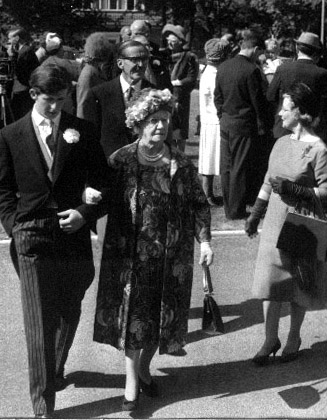
"Gran Smith" as I remember her; at Michael's wedding in 1959. Myself on the left, Mum on the right and Dad behind.
(2) Dan Smith (died in Sutton, England 1934)
| Relationship to me: | Grandmother "Gran Smith" | Gen -2 | "Gran Smith" as I remember her; at Michael's wedding in 1959. Myself on the left, Mum on the right and Dad behind. |
| Born: | 2nd December 1874, Birmingham Warwickshire | ??? | |
| Died: | 22nd December 1969, Harborne, Birmingham | ||
| Age | 95 | ||
| Father: | Robert Kilpatrick Wake | 1848 - 1892 | |
| Mother: | Adah Rhodes Nelson | 1849 - 1921 | |
| Brothers: | None | ||
| Sisters: | Adah (Bessie) (m Wall) | 1872 - 1963 | |
| Annie Margaret (m Stocks) | 1876 - 1970 | ||
| Nicholas (m Blackwell) | 1881 - 1961 | ||
| Gladys | 1884 - 1885 | ||
| Married: | (1) George Richards (died in India around 1903) (2) Dan Smith (died in Sutton, England 1934) |
||
| Children: | Robert Richards | 1900 - 197? | |
| Margaret Helena (m. Newman) | 1907 - 1965 | ||
| Phyllis (m. Evans) | 1910 - 1986 | ||
Notes: Gran was a remarkable woman, and I know too little of her history. However Oliver Suffield (my second cousin) has been kind enough to provided me with an outline of her family tree that has enabled me to fill in a lot of details which I have incorporated into this and related pages.
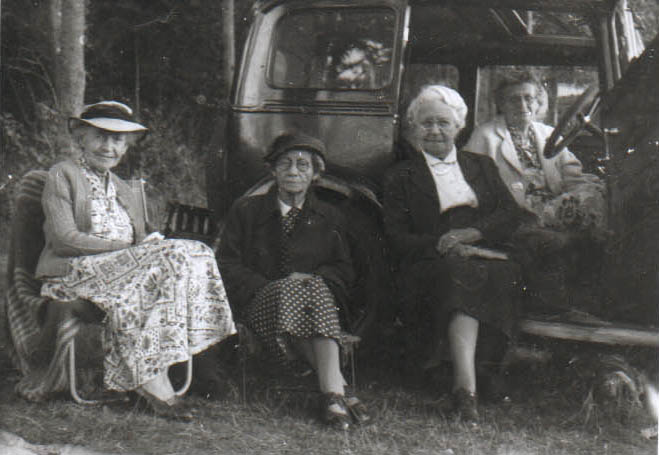
Outline her Life:
Gran Smith was born in Birmingham when Benjamin Disraeli was Prime Minister of Britain. She must have been well educated since I was told that she was one of the first women to graduate from Birmingham university, graduating with honours in Mathematics. (My father told me this and thought that she went to university in 1892). However, in the taped recording made with her grandson Michael Evans in early 1969 (the year of her death), she mentions that she chose to go to college in London and not Birmingham (see transcript below).
Sometime in the late 1890s she followed her mother's example and sailed to India, travelling via the Suez Canal which had been opened in 1869. I don't know whether she met her first husband (George Richards) in India or whether it was before she went their, but either way, he and she became head master and head mistress at the Karachi Grammar School (at the time, a school for expatriates' children, but still in existence in 1969 at the time of the taped interview). In 1900 she had a son Robert (known as "Dick"), who joined the Royal Engineers as a contemporary (and friend) of my father.
When travelling by train with George Richards to the hills in the heat summer, he became suddenly ill with fever and she had him taken off the train at around 1.30 in the afternoon. The surgeon from a nearby army hospital attended to him later in the day by when his temperature was 108 by when there was nothing to be done to save him. He was dead and buried by 9.30 the same evening. (Her description of this event is preserved on the above tape-recording as transcribed below).
My father told me that she became head mistress of a school for the daughters of "Other Ranks" at Ootacamund in Southern India, which appears contrary to her own words about being head mistress of the Karachi Grammar School. Perhaps she was involved with both schools at different times.
I don't know when, where or how Gran met Dan Smith, but they married around 1906 and had two daughters, Margaret and Philis, both born in India. She returned to England in 1921 and moved to Sutton (SW London) until Dan's death in 1934 (see below), then moving to a house in School Road, Moseley,West Midlands (near Birmingham) around 1935.
Gran returned to India in 1938 to look after "Dick" after his wife, Marcia, had "gone home in disgust" (my father's words) after her son had died. Gran was forced to stay on when war began because there was no means of returning to England, and she became well known amongst army wives (including Patricia Richards, later Patricia Newman who was also there) as the chief organiser of "war-effort" work by military wives - specialising in knitting of socks and balaclavas for soldiers, I believe, and making clothes etc for the local hospital. (This was typical of her character:- indefatigable, inexhaustible, organised and organising, and possessing a razor-sharp mind, right to the day she died). Anyway, for her efforts, she was awarded the "Kiser-i-hind" decoration for civilian services in India.
She returned to England around 1944, selling her house in Moseley and moving to Ashtead to live with my parents. Her husband (Dan Smith) had died penniless and left her nothing but the savings that she'd kept of her own (as she often told us) which she invested in the stock market (in solid companies like Woolworths and Marks and Spenser, which profited well). She was by then quite wealthy (compared to my impoverished parents) - wealthy enough anyway, for her to pay out the £4000 that it cost to buy Churchlands Farm in Somerset where I grew up (and wealthy enough to be relied on to dish out £5 notes to each of us children for Christmas and birthdays!) As I understand it she and my parents came to an agreement in 1947 that she would buy the house for them on condition that she was allowed to live in it, and this she did until around 1959 or 1960. I think her decision to move was partly due her failing eyesight and partly (I suspect) due to friction that developed - my father finding it uncomfortable living with his mother-in-law for so many years. Also, by then, my father's mother (Lilian) had died leaving him a substantial inheritance, which, I imagine, enabled him to buy the "farm" off Gran Smith when she left.
At that time, Gran Smith moved to Harbourne near Birmingham, where she lived with my mother's sister Phil who had been widowed for some years, listening intently to the daily news bulletins, and sitting so close to the television that it was hard to imagine it being possible for her to be able to see anything on it even if her eyes were functional. She loved to grumble about what she saw as the deterioration of English diction on TV and radio (an irritation I now share with her!).
Her death in 1969 followed quickly after a fall which broke her hip (if I remember rightly). Prior to the fall, it appeared that she would sail past her century in fine fettle, but she had to make do with 95 - which she loved to tell everyone was rather more than she really wanted. A wonderful woman who I still miss dearly.
Two childhood recollections I have of Gran Smith were (a)
she had a relative who came from Dumfries (which happens to be where I was married);
and (b) that she had a relative who was Captain of the Great Eastern steamship
when it laid the first Atlantic telegraph cable (in around 1876).
Oliver Suffield provided me with the facts behind these memories: (a) her great grandfather Robert Wright was a baker from Dumfries; and (b) it was Robert's Wright's sister-in-law Agnes Anderson's son, Sir James Anderson, who captained the Great Eastern steamship. He must therefore have been Gran Smith's first cousin once removed.
Gran must have been very familiar with this side of her family, because amongst the many people she mentions in the taped interview with Michael shortly before her death, she mentions a William Costen Aitken who was born in 1817 and died in 1875. William Costen Aitken was the husband of Robert Wright's daughter Elizabeth.
(The above combines my own childhood memories with notes made during a conversation with my father in Australia during his last visit in 1986 or 87. Supplemented also by the taped recording with Gran Smith in 1969 transcribed below, and information obtained by Nadine Price, and given to me by Oliver Suffield).
This is my transcription of Tape Recording with Gran Smith (G:) made by Michael Evans (M:) on 10th Feb 1969, just 10 months before her death:
(1) M: Book with drawings by Alexander Munro. In the front is a letter from Randolf Churchill; G: The letter has nothing to do with book - something to do with the Birmingham Conservative Association, because my father was very keen about politics. M: Letter says: "From Blenheim Palace 31st Jan 1884: Dear Mr Barton, Many thanks for your letters and enclosures, which both will no doubt be gladly adopted. I'm going to make a few remarks to my constituents on Brighton and Birmingham. Yours very truly Randolf Churchill".
(2) M: Another letter: "from Birmingham Town Clerk's office dated 12 May 1875 to Mrs Aitken, Mayfield, Hanver(?). By the direction of the council of this borough, I beg to transmit to you the accompanying resolution adopted by the council yesterday, of sympathy and condolence with you on your recent sad bereavement by the death of Mr Aitken. Permit me to add the expression of my own personal regret at the event that has deprived you of an affectionate and devoted husband, and of myself of a much esteemed and honoured friend. I am, dear Madam, yours very truly E.G. Hayes, Town Clerk".
(3) M: Another letter: "6 Aug 1890: from R.K.W. (her father): My dear Ellie, I sent you a hurried PC last night. Bessie had had a very bad night and this morning I sent for Dr Quirk. He says it is acute rhumatism and her heart is very weak. Aunty says it is getting worse and worse. Your ma is getting very low spirited, so we are all in a dump here. If your grandma can spare you tomorrow, come down and see Bessie. I have written to Mr Wilks and also Betsie. Hope you are well at home. With united love, believe me, your affectionate Dad, RKW". G: I was known as Ellie until she went to college and was then known as Lina.
(4) M: Letter 29 November (no year) Victoria Villa, Heaton Hall Road, Newcastle on Tyne. G: I think it's from Aunt Ellie to me … but you'll find it too hard to read!
(5) M: Pictures of sculptures by Alexander Munro … cuttings from Birmingham papers - all obituaries (to Alexander Munro). And letters to 8 Richmond Terrace, Whitehall … more obituaries … died at age of 44 of consumption …picture of a statue of James Watt outside the Town Hall, sculptured by Alexander Munro …
(6) M: Minutes of Council of April 1875" G: Is that when Uncle Aitken died …. There should be a photograph of his gravestone. That was subscribed for and there was small stain-glass window in Hansworth old church in memory of him. He must have been an extremely nice man. He has a nice peaceful expression on his face. M: Why the interest in Alexander Munro ? G: I suppose Uncle Aitken and he must have been friends, or he approved of his work. What does it say on the tombstone? M: reads "This stone is placed in loving memory of William Costen Aitken by friends who knew his worth and mourn his loss. Devoted to that which he knew to be good, he spent the best years of his life in teaching men how work was richly ennobled when thought was joined to labour and beauty wedded to skill. Born in Dumfries, 3rd March 1817, Scotland, died Birmingham 24 March 1875". A nice tombstone! G: Yes - it must be in Hansworth old church.
(7) M: Letter here with an old envelop with a 1d red stamp on it: from Elverton Lodge, Birmingham, to Mrs Aitken, Mayfield 14th Oct 1879. "Dear Mrs Aitken, I'm very glad to tell you that the monument to your good husband and my dear old friend is now finished and placed ……. only that the shrubs shall grow up around it to complete its beauty as a work of art. You will find also that the plaque over the grave of his brother, artist Francis Aitken*, has been replaced and that it is a work that my good old friend would have delighted to do to the memory of one who he honoured so much. I hope you will approve of the inscription, the result of very much thought and care. It has certainly the merit of being absolutely truthful in every word. The director has been good enough to offer a guinea for each monument, but I am not yet sure that we ought to accept so kind an offer as we shall have a balance over, and we all felt that the memorial should be from personal and lifelong friends. Faithfully yours, Sam Fimmins or Finnigate*. (Michael has trouble reading these bits)
(8) G: I had remembered seeing a letter from Sir John Jaffrey, the one who founded the Jaffrey hospital, called himself Beak of the Brother …. ????
(9) M: There's this little tablet with a clip on it….. a picture of W.C. Aitken, and a cutting from the Birmingham Post, dated 1935 with an article 50 years ago reproducing an article from Birmingham Post in 1885 on the Corporation Art Gallery. G: I think I remember: I'd just come to Moseley and Bess had sent it to me there.
(10) M: This book is the Deed of Foundation of Josiah Mason's Scientific College ….. got this cutting from the Birmingham Post again, of 50 years ago.
(11) M: Also got this Port Bannatyne ….. I asked Melville about it, and he's going to let Michael have a book all about Port Bannatyne. He thinks that maybe that this William McLeod Bannatyne is related to the Marquis of Bute, because the Marquis owns all the Isle of Bute and property elsewhere, and he thinks there may well be some family connection. He's going to give me a lead by letting him have a book; because they go and stay there, you see. G: It must have been amongst my paper, and possibly Peg was reading it and perhaps it got amongst hers. Henry found it, but none of his people belonged to Scotland …..But evidently a friend or relative of some of the Dumfries people. Henry found it and sent the book to me about three or four weeks ago.
(12) M: If some of this stuff not of any interest to you, we might as well throw some of it away. What do you think? Because Mum is always saying she's going to have a good old clear out." G: Yes I know. She'd send half the stuff to the jumble. She's not interested in it at all …… I don't want them destroyed. In the future someone may like to read them, and as I've kept them through all sorts of conditions, I don't want them to be thrown away indiscriminately.
(13) …M: This stuff is all about Josiah Mason's College. Here's an invitation" "Bailey and Trustees of Josiah Masons Science College request the pleasure of the company of Mrs Aitken and Lady at the opening address by Professor Huxley in the town hall Birmingham on 1st October 1880 and at a soirée at the college at 8.00 in the evening. An early answer on the accompanying form is requested when tickets of admission will be sent". What is a soirée? G: Soirée was an evening show, dancing and that sort of thing. Very popular at one time and the Womens(?) Institute often had them. Before my father died, he used to go regularly every week to lectures. They were usually given by some well-known person, big scientist or big literary man. I think Mother used to go with him to those as well. At the time, I was doing science, and I had my science lectures on Monday evenings, and we all came home and talked about it".
(14) M: There's a little letter here from Pensan Abergelly from Josiah Mason. "Dear Mr Aitken, The same influence that directs my energies to accomplish a benefit for man must influence you in accepting an office that can only have the same object in view. Sincerely thanking you, sincerely yours, Josiah Mason". Was that taking office of the trustee? G: Yes. M: Is the Josiah Mason's Science College in existence then? G: No, it was absorbed, I think, by the university. Because after I finished my apprenticeship as a pupil teacher, we had to pass what was known as a Queen's Scholarship exam to get into different colleges. I could have applied to go to Mason College, but I didn't want to go as a day student. So I went to a London college instead. Had I gone to Mason College I should have gone as head girl because I was top of the students in Birmingham". M. What did you teach? G: Ordinary subjects later. I didn't specialize. Then when I went out to India, Dick's father and I were joint head-master and mistress of the Karachi Grammar School. And it's only two or three years ago that the Duke of Edinburgh attended the centenary celebrations (of the school) when he was out in India. So it's still in existence.
Then Dick's father died on the railway as we were going up to the hills …. He was taken ill in the train, then when we got to … what was the name of the place? But I got out to call a porter to help me to get him out of the train. But I shouldn't. I should have waited until we got to the Contument(?) Station. I got out at the City(?) station (which was) amongst all the native population. Contument is where all the military had all their bungalows. However the Permanent Way Inspector was a very nice man, and when he found out that Dick's father had been a Mason he helped in every possible way. Well, George was taken into the station waiting room and they had to send to the Contument for the civil surgeon, and when he came he said there was no hope at all because his temperature was 108. And on his way back to the Contument, he must have ordered a coffin to be sent to the station, because he couldn't be kept in the waiting room. I think the train got in about 1.30 and at about 9.30 the same night he was buried. The Permanent Way Inspector made all arrangements. They hadn't a hearse or anything of that sort; they had a most peculiar vehicles in those days covered in with a narrow door on either side and for ages I could see this coffin stuck on top of that funny little vehicle. It was an awful nightmare.
Then fortunately, one of the students who had been in college with me was teaching at a big school run by the railway up in the Himalayas at a place called Mitsuri(?). I had discovered that she was there, and she had come down the previous Christmas to Karachi and had spent the holidays with us. I think I must have sent her a wire because she and the headmaster came down to the foot of the hills because the only way of getting up to where they were was. … when you got out the train you got into a sort of 'tonga', a vehicle with a cover over (a hood) with seats back-to-back; the driver sat in front and you got on the back seat. You want as far as it was possible for horses to pull these things, and then you had to change into rickshaws and then you could go only so far in the rickshaws. After that they couldn't pull the rickshaws - it was too steep. The last part, you were carried up in what were called "dandies"; it's like a hearth rug folded up at each end on pole, and you sat in it, while four coolies carried the poles on their shoulders. Your luggage was carried up by porters; they used to have a strap round their heads and used to carry these enormous trunks and things. And I had a very heavy one at Sarratoga which I left down at the farm: it had Iron clamps on and solid wood; they were used at the time. But once having been up to the Himalayas and got back again, I would never take such a heavy case up again for those poor devils to carry. It was dreadful. You would see them carrying wardrobes and glory knows what. Even in Karachi when people moved house, there were no such things as furniture vans; everything was carried on their heads by coolies - you would see a wardrobe or dressing table floating down the road on the coolies heads!"
(15) M: "Going back to modern times - I have a green book called "Encyclopaedia of Art Industry" edited by W.C. Aitken. Is that of any interest to you? G: Oh rather. He was so interested in making things beautiful. Not just any sort of design. I wouldn't lose that book. There must have been others as well. M: "Would they be of interest to anybody else? Perhaps the art gallery or museum?" G: "I don't know. Wendy might be interested in some of it. It would be a pity to throw them out just because they're of no interest to just one or two, when others may be interested".
(16) M (looking at photos): Here's one of you - Mary Nelson Helena Wake 1894. G: Yes - that's when I was in college. M: Sweet photograph - hair back in a bun. Here's one of Robert Kirkpatrick Wake, that's your father - a little tiny photograph. And another one of your mother standing behind a chair. And then there's one of Aunt Aitken in all her magnitude! She was huge! And here's one of your mother and you and your two sisters in a garden with a greenhouse at the back. Your mother sitting down, you on the right. G: I'm standing up very stiffly, and then there's Daisy and Nin. M: There's one with long flowing hair: that must be Daisy. I think Nicki is the other on the left: she has fuzzy sort of hair. You on the right with a sort of bonnet on. G: Betsy isn't there; M: No but Daisy's at the back with long hair down to her shoulders.
(17) Another photograph? M: That was by Jugendra Singe. What was that about? G: That was given to me by the wife of the author. She was married to an Indian. M: With love from the author's wife Xmas 1925. G: He was an awfully nice man. I think he was Sikh. I think he was Minister of Education in the Punjab. She was a second wife. I'm not sure but I think she may have had a little dark blood in her, but she'd been educated in Brussels, and I met her on the boat coming home once.
(18) M: The next one here is Tennyson's Works. G: That was a prize wasn't it. Or was it Wittier? M: No, this is just a book. Here's one called ?? Names and Emblems of Jesus Christ. G: Oh that was written by a friend of Aunt Aitken. M: By A.G. Somner. G: Yes - it was one that Aunt Aitken gave me.
(19) M: Here comes Le Wittier. G: I think that was a prize. M: That's right. Sparkhill Green South(?) Birmingham Institute. Prize awarded to Mary H.N. Wake for success in Hygeine and Physiology at the examination held in 1897. G: That was after I came out of college I still went on studying. There are several of my books and prizes that are lost.
(20) M: Another book, Henry Longfellow. Nothing special about that; no reference to prizes. It cost 3/6d! Here's another book called MacCauly's Essays. G: Oh yes - I did several of those essays. McCaulay's …. and Life of Byron, Madam Darglave was another ….. I expect it belonged to my father.
(21) M: And then we have a Volume of verses, serious, humourous and satirical by Will Buchanan; to Mrs McLellan from the author, Will Buchanan. "In recollection of such kindness and attention from her husband and herself while his wife and he stayed at Daisy Bank, Noble Hill. Will Buchanan, Ayr, 21st April 1866". G: I can remember the names - there were the Andersons, Arnotts, McLellans, Wrights, Richardsons, they were all Dumfries people. I used to stay with the Richardsons sometimes when I was in College; they had a lovely house in South Croydon, and it was such a treat to go into a house with lovely stair carpets and carpets after the wooden stairs in college. She was a very handsome woman. They also came from Scotland.
(22) M: ……. Looking at more books.. H.G. Wells … McCauley's Biographies, then Shakespeare's King Lear. G: "Oh! King Lear! I wouldn't have parted with that. We did it as an English subject, and the elecution mistress that took us for it made it absolutely live, and for years I couldn't go and see it acted on the stage ….. she was wonderful".
(23) M: Here's another one. "To Gran with love; Patricia, Xmas 1941", Leaves in the Wind". G: Patricia Richards. They live near Bristol.
(24) M: Here's another one - Groundwork of British History, George R. Richards … this is Uncle …. (?).. printed in 1912.
(25) M: Sermons on the 23rd Psalm ….. (sound lost)
(26) M: Another one: Mrs Elizabeth Wright written inside. G: That's Aunt Aitken. M: The Dramatic Works of William Shakespeare; G: What date is that? M: MDCCCXXX. That must be 1830. So it's 140 years old and in remarkably good condition. All the pages are intact. A very well kept book. G: Some of our books were ruined in the cyclone in Karachi. I have got one or two books where the bindings were spoilt.
(27) M: Here's nother fairly ancient one - this is Pilgrims Progress by John Bunyon: "Miss Aidah Nelson, first prize for writing, from Mrs. Frazer, Dec 1863", and you've written Poonah(?) there. G: Mother was in boarding school in Bombay. And Dr Frazer was head of the school. So that must have been mother's prize. M: This is also very well kept, this book, because they bound them well, didn't they.
(28) M: Book of Common Prayer ….. Shelley ….. New Testament …issued by the King to his forces. Then there Lady of the Lake, "To Mrs Wright from a friend 20th Feb 1846".
(29) M: Then there's Burns Poems, Vol 1 and Vol 2, "To Chummy, with Kitty's love Dec 2nd 1895". G: That was from my first chum. M: Who was Chummy? G: I was. M: Who's Kitty? G: She's the one who gave it to me.
(30) M: Common Prayer with ivory cover and clip …. (lots of talk without much direction - getting a bit hard to follow). End of recording.